
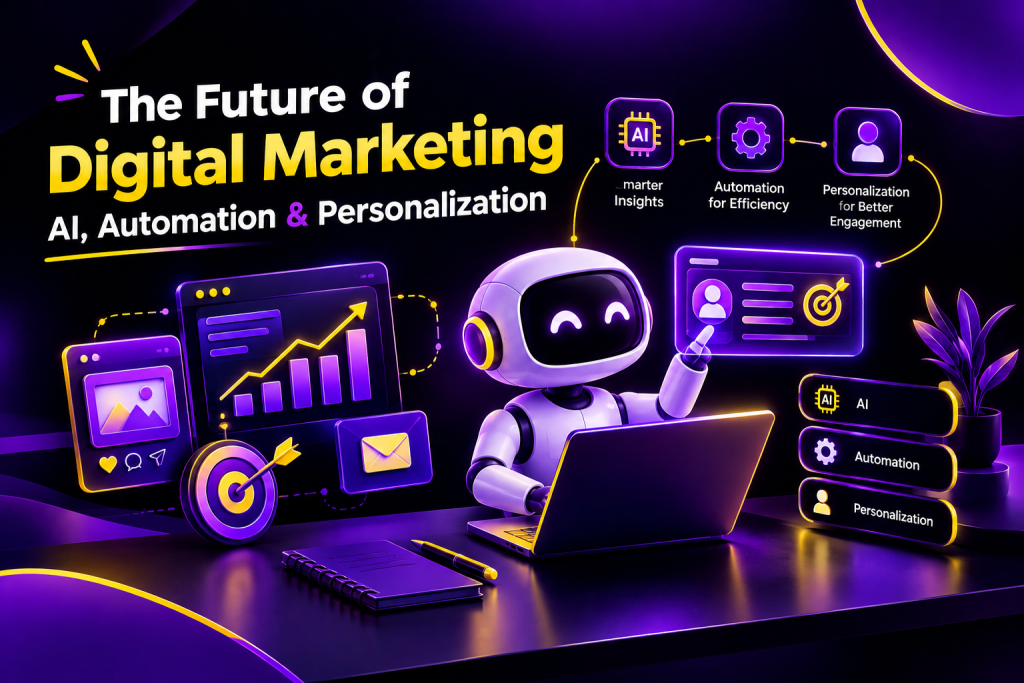
Future of Digital Marketing: AI, Automation & Personalization
How Is Digital Marketing Changing? Describe how digital marketing is evolving from traditional marketing toward the use ofdata-based decision making real-time customer exchanges,automated business processes,personalization,AI-driven content,predictive analytics,andmultichannel marketing in simple language. Make a brief statement showing how a business could use multiple channels to market its products. The Role of AI in the Future of Digital Marketing Describe how AI can help marketers with: Content creationCustomer insightsSearch optimizationAdvertisingData analysisAudience segmentationCustomer supportCampaign optimization Make it clear that AI is a tool that augments the marketing team, and not an immediate replacement for human creativity, strategic thinking, judgment, and brand savvy. H3: AI-Powered Content Creation Explain how AI can help marketers to create: Blog ideasContent outlinesSocial media ideasEmail draftsProduct descriptionsAd variations And note that human oversight, fact-checking, editing, originality, and brand voice are still vital to the process H3: AI-Powered Customer Insights Explain how AI can help analyze large marketing data sets to uncover trends, audience preferences, and customer behaviors. H3: AI in Advertising Explain how AI can help with: Audience targetingAd variationsCampaign analysisBudget optimizationPerformance insightsBut refrain from making unsupported claims about improved advertising effectiveness. H2: The Growing Importance of Marketing Automation Explain what marketing automation is in simple terms. Marketing automation refers to using different software and technology to automate and streamline marketing tasks. Explain how marketing automation can benefit organizations by providing: Email campaign automationLead nurturingCustomer segmentationSocial media marketingFollow-up emailsAutomated notificationsReportingWorkflow managementH3: Benefits of Marketing Automation Discuss: Time-savingReduced drudgeryConsistencyImproved lead-nurturingMore agilityEnhanced organizationH3: Examples of Marketing Automation Give some examples of marketing automation. For instance, a customer subscribes to a website, gets a thank you email, gets valuable content, gets an offer, and gets a follow-up message. The key point is to personalize the buyer’s journey based on their needs and the timing of their purchase. Why Personalization Is the Future of Customer Experience Explain personalization in simple language. Show the difference between Generic marketing and Personalized marketing Explain how personalization can use information such as interests previous interactions purchase history website behavior content preferences audience segments in order to make marketing communication more relevant. H3: Personalized Email Marketing Explain how businesses can personalize subject lines content recommendations offers timings H3: Personalized Website Experiences Explain how websites can provide more relevant content, recommendations, or messages based on visitor behavior where appropriate. H3: Personalized Advertising Explain how businesses can create different advertising messages for different audience groups. AI + Automation + Personalization: A Powerful Combination Explain how the three technologies work in tandem. Use the following format in your example: AI understands data Automation delivers relevant actions Personalization makes the experience more relevant. Show how one business could use all three technologies at various stages in the consumer journey. Use the following structure in your example: A customer visits the website Insight is gained on the customer AI identifies content or demographic information Automation provides a relevant communication Something is personalized Analytics is used to analyze the response. Future Digital Marketing Trends to Watch Discuss important trends that businesses should watch out for. Make sure to include: H3: AI-Powered Search and Marketing Explain how AI is changing the way searches are done and how discovery happens. H3: Conversational Marketing Chatbots, AI-assisted conversations and similar approaches fall under this category. H3: Predictive Marketing Explain how businesses can use data and AI to identify potential patterns and behaviors among customers. H3: Hyper-Personalization Explain how marketing can become more finely-tuned to different segments and contexts. H3: Automated Content Workflows Explain how businesses can use AI and automation to aid in the creation, planning, publishing, scheduling, and analysis of content. H3: Data-Driven Decision Making Explain why companies will be relying more on data and analytics to make marketing-related choices. Avoid presenting these as certainties. Benefits of AI, Automation & Personalization for Businesses Explain the key benefits, including: Greater efficiency,shorter marketing cycles,more relevant customer experience,optimized marketing data,increased productivity,consistently branded communication,improved customer understanding,andgreater marketing scalability. Explain that results vary based on implementation, strategy, data quality, and business objectives. Challenges Businesses Need to Consider Do not suggest that AI and automation is always a positive and perfect solution. Make sure to address challenges like H3: Data Privacy by discussing why businesses should be responsible with customer data H3: Maintaining Human Creativity by explaining why human creativity, imagination, storytelling, empathy, and strategy should not be lost, H3: Accuracy and Quality by explaining why AI produced content should be well-researched and factually accurate, H3: Over-Automation by describing how automation can lead to impersonal and unempathetic communication, H3: Choosing the Right Technology by explaining companies should invest in the technology that addresses their specific business needs and not simply adopt the latest trends. How Businesses Can Prepare for the Future of Digital Marketing? Offering a real-world perspective. H3: Step 1 — Know Your Customer Inside Out Motivate the businesses to research their customer base and understand their demands and behaviors. H3: Step 2 — Develop a Strong Digital Presence Include such subheadings as create a website, SEO and content marketing, leverage social media, analyze data, and enhance customer experience. H3: Step 3 — Begin with Small and Straightforward AI-Driven Tasks Advise businesses to invest in simple and effective AI-driven automation rather than attempt to digitize their whole operation at once. H3: Step 4 — Automate Everything That Can Be Automated Explain what repetitive and monotonous tasks can be substituted by AI-driven automation tools to make the operation more efficient. H3: Step 5 — Use Personalization Wisely Remind the readers not to overlook the importance of personalization, which is critical for engaging and retaining clients. H3: Step 6 — Measure and Optimize Frequently Asked Questions (FAQ) 1.What is the future of digital marketing? The future of digital marketing will focus more on AI, automation, personalization, data-driven strategies, and better customer experiences. Businesses will increasingly use technology to understand their audiences and create more relevant marketing campaigns. 2. How is AI changing digital marketing? AI is helping marketers analyze data, create content, understand customer behavior, optimize advertising, improve SEO workflows, and provide faster