Uncategorized

Uncategorized

“From Clicks to Customers: The Digital Marketing Journey”

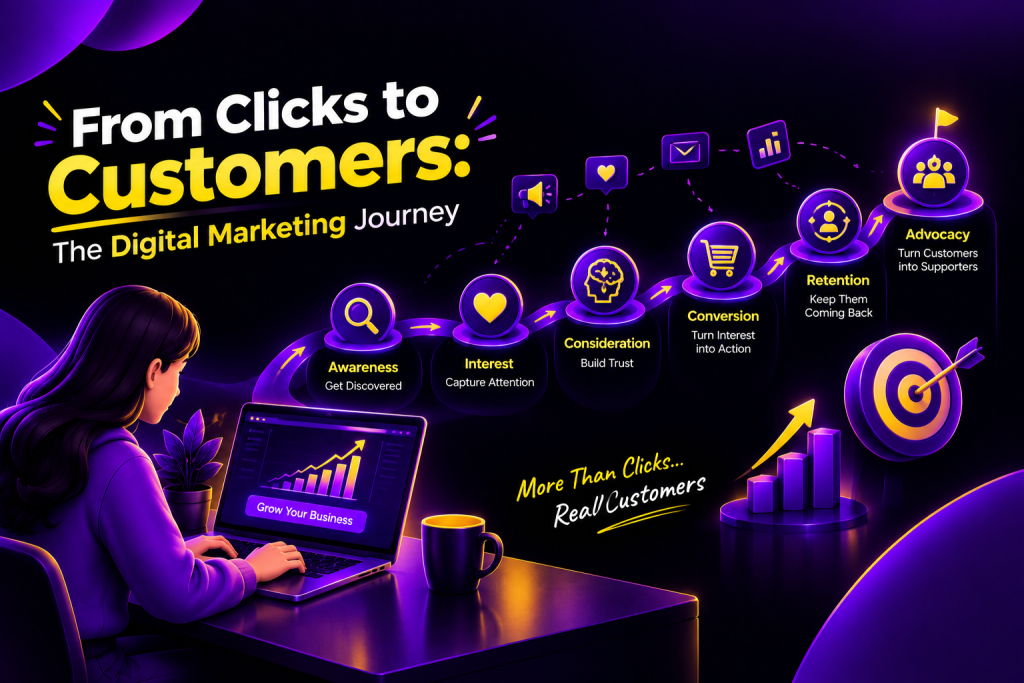
What Is the Digital Marketing Journey? Define it as the process a person goes through from identifying with a brand to engaging with it, considering its products or services, buying them, and, possibly, becoming a brand loyalist. Explain that each customer’s journey is unique Elaborate on such factors as customer needs,industry,product price,brand trust,competition,customer experiencemarketing channels The Main Stages of the Digital Marketing Journey Discuss Channels such as: Google SearchSocial mediaGoogle AdsOnline videosBlog contentRecommendationsDisplay advertising Explain the role to SEO and content marketing. Example: A person searching Google for “best digital marketing services for small businesses” finds a company’s website. H3: 2. Interest — Capturing Attention Explain the interest stage (after discovery). Businesses should provide value and encourage the visitor to stay on the website and learn more. Discuss: Helpful blog postsSocial mediaVideosInfographicsEducational contentWebsite pages Explain how valuable content encourages the visitor to spend more time learning about your brand. H3: 3. Consideration — Building Trust Explain that potential customers will typically compare several businesses (in their consideration set) before purchasing. Discuss how a business can gain trust with customers by including: Customer reviewsTestimonialsCase studiesHelpful contentService informationFAQsProfessional website designSocial proof Explain why credibility matters at this stage. H3: 4. Conversion — Turning Visitors Into Customers Explain what a conversion is. Examples of conversions include: Making a purchaseCompleting a formBooking a consultationCalling a businessSigning up for a serviceRequesting a quote Explain how a business can improve conversions using: Clear CTAsSimple formsStrong landing pagesNavigationRelevant offersTrust signalsMobile-friendly design Explain that not every click will result in a customer. H3: 5. Retention — Turning Customers Into Repeat Customers Explain that digital marketing does not end with a sale. Discuss how a business can continue to engage with a customer and turn them into a repeat buyer. Possible examples: Email marketingPersonalized communicationLoyalty programsHelpful contentFollow-up messagesProduct recommendationsCustomer support Explain why it is an important component of the marketing strategy. H3: 6. Advocacy — Turning Customers Into Brand Supporters Explain what customer advocacy is. Discuss examples of how customers can advocate for your brand, such as:ReviewsReferralsSocial media mentionsTestimonialsUser-generated contentWord-of-mouth recommendations Explain how you can encourage customers to advocate for your business voluntarily. Do NOT claim that all of your satisfied customers will become brand advocates. How Digital Marketing Channels Work Together Explain that companies should not necessarily think of SEO, social, ads, content, and email marketing as separate activities. Explain how different activities could support different phases. Create a simple table: From Clicks to Customers: Why Traffic Alone Isn’t Enough Traffic Discuss why businesses should look beyond: Clicks Impressions Followers Views Business resultsand also consider: Leads Conversion rate Customer acquisition Sales Repeat purchases Customer lifetime value How to Improve the Digital Marketing Journey Provide practical strategies. H3: Know your audience Explain the value of understanding customers including their needs, questions, concerns, and preferences H3: Create useful content Explain the value of educational and relevant content to guide customers through the buyer’s journey. H3: Optimize the website Discuss: Responsiveness on mobile devices Speed of website Navigation ease Effective Calls to Action Clear information about the service or product H3: Build trust Include: Reviews Testimonials Case studies Providing information and building professional brand imagery for the business H3: Use data Explain how the use of data can help businesses learn where their customers are leaving the customer journey or where they need help. Common Digital Marketing Mistakes Businesses Should Avoid Describe the common mistakes like: H3: The Focus on Quantity explain why the increase in traffic without the right visitors or poor conversion rate will not bring the desired results H3: Poor Website Experience explain why the complicated website structure and the poor user experience kill any marketing efforts H3: Trying to Use Any Marketing Channel explain why the company should not use every channel available but instead chose the most suitable ones according to their needs H3: Lack of Follow Up explain why the lead nurturing campaigns via email marketing or other channels are essential H3: Lack of Focus on Current Customers explain why the current customers should be engaged in the marketing campaigns too How to Build a Simple Digital Marketing Funnel Give one example of a practical business application of this information. Use this structure: Awareness SEO + Social media + Google Ads ↓ Interest Blogs + Videos + Educational Content ↓ Consideration Services + Reviews + Testimonials + Case studies ↓ Conversion Landing page + CTA + Contact form ↓ Retention Email marketing + Customer Support + Valuable Content ↓ Advocacy Reviews + Referrals + UGC Explain each step briefly. Frequently Asked Question (FAQ) About the Digital Marketing Journey 1. What is the digital marketing journey?Digital marketing journey encompasses the entire process of getting a customer from being aware of a brand to ultimately purchasing and even advocating for the business. 2. How do clicks turn into customers?Clicks can be turned into customers when businesses have the right content, build trust, offer a good experience on their website and include CTAS. 3. What are the main stages in the digital marketing journey?The main stages in the digital marketing journey are awareness, interest, consideration, conversion, retention, and advocacy. All these stages are crucial for the customer journey. 4. Why is SEO important in the customer journey?SEO allows the company to appear in front of searching customers and generate traffic to the business, resulting in the conversion. 5. How does social media help to attract customers?Social media helps attract customers by building brand awareness, providing informative content about the business, connecting with potential customers, and displaying the products and services. 6. How does content marketing help to convert visitors?Content marketing assists with educating customers, building trust, and establishing credibility to get more customers to convert. 7. What is the difference between a click and a conversion?A click is registered when a person clicks on a link while a conversion happens when a person takes the desired action such as making a purchase. 8. Why is a good website so important to turn visitors into customers?A good website
Uncategorized

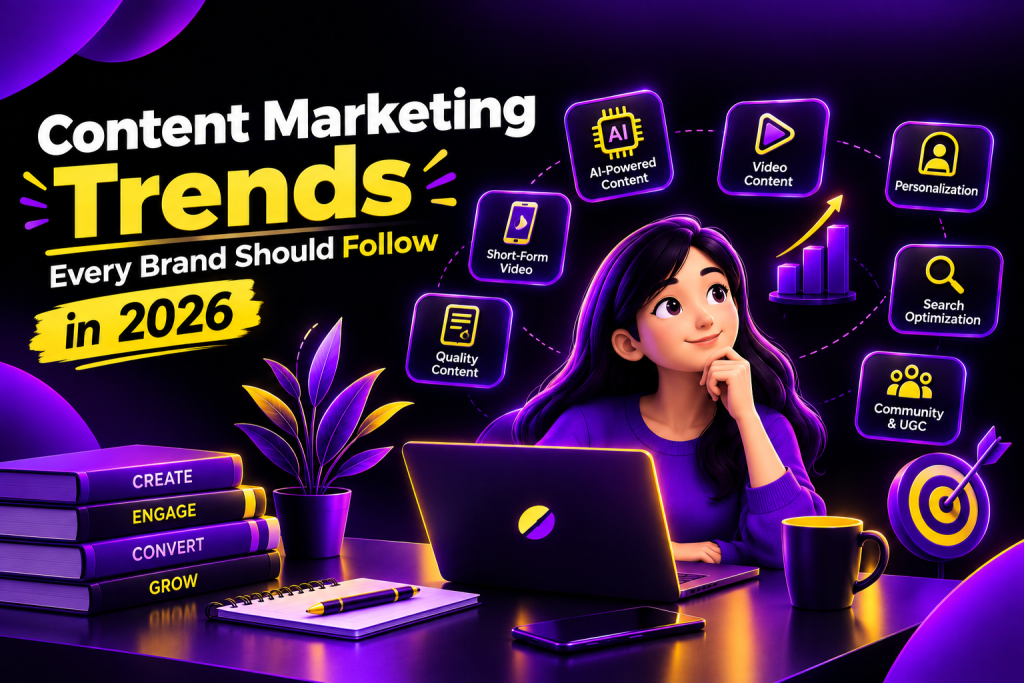
CONTENT MARKETING TRENDS EVERY BRAND SHOULD FOLLOW IN 2026

INTRODUCTION Explain how content marketing has evolved. Note that audiences are exposed to an overwhelming amount of content daily, making it vital for brands to produce content that is:Helpful relevantauthenticeasy to findengagingpersonalized Introduce 2026 as a year that marketers should focus on AI, personalization, video, search, community, and authentic brand communication. Close the intro by briefly describing what the reader will learn in the article. Why Content Marketing Still Matters in 2026 Explain why brands continue to use content marketing to: build awarenesseducate customersbuild trustsupport SEOgenerate leadsengage audiencessupport customer journeysstrengthen brand identity Explain that publishing more content does not automatically mean better marketing. Focus on quality, relevance, usefulness, and consistency Top Content Marketing Trends Every Brand Should Follow in 2026 IntroductonBegin by introducing the main trends and then elaborate on each trend. Use H3 headings for each of the trends. H3: 1. AI-assisted Content Creation Explain how AI is becoming an integrated part of modern content workflows Explain how AI can help marketers with: Content ideasResearch assistanceOutlinesDraftingContent repurposingPersonalizationEditingBrainstorming Important: Explain that AI should complement human marketers rather than completely replace human creativity, expertise, editing, and judgment. Note the importance of: Fact-checkingOriginalityBrand voiceHuman reviewAccuracyH3: 2. Short-form Video Content Explain why short-form videos are an important content format for brands. Discuss platforms such as: Instagram ReelsYouTube ShortsTikTok where relevant and based on current availability. Explain how brands can benefit from using short videos for: Product demonstrationsEducational tipsBehind-the-scenes contentCustomer storiesQuick tutorialsBrand awareness Do not claim that short-form video can guarantee virality. H3: 3. Personalized Content Experiences Explain how brands are seeking to move away from generic content to more relevant experiences. Discuss personalization based on appropriate information such as: Audience interestsPrevious interactionsCustomer segmentsContent preferencesPurchase behavior Explain why offering relevant content can be a good way of enhancing the customer experience. Also note the importance of responsible data use and privacy. H3: 4. Search-focused and Helpful Content Explain why brands should be creating content that answers questions and satisfies search intent. Discuss: Helpful contentTopic relevanceSearch intentClear answersStructured contentNatural keyword useFirst-hand expertise where appropriate Explain that brands should be creating genuinely helpful content rather than writing solely for the purpose of targeting keywords. H3: 5. User-generated and Community Content Explain what user-generated content means. Examples: Customer reviewsTestimonialsCustomer photosCustomer videosSocial media mentionsCommunity discussions Explain how authentic customer experiences can enhance trust and brand credibility. Do not claim that UGC can automatically drive sales. H3: 6. Interactive Content Explain how interactive content can be a good way to engage with the audience through methods such as:QuizzesPollsCalculatorsSurveysInteractive toolsAssessments Interactive infographicsDiscuss how brands can use interactive content to educate the audience and encourage participation. H3: 7. Content RepurposingExplain how brands do not always have to create completely new content from scratch.Give a practical example of how one long-form blog can be repurposed into:Instagram postsLinkedIn postsShort videos Email contentInfographicsShort tipsFAQ contentExplain how content repurposing can help brands to maximize the value of their content.H3: 8. Authentic Brand StorytellingExplain why audiences are more likely to connect to brands that communicate in a clear and authentic manner. Discuss:Brand storiesBehind-the-scenes contentFounder storiesCustomer storiesCompany valuesReal experiencesExplain the difference between authentic storytelling and exaggerated promotional content.H3: 9. Data-Driven Content MarketingExplain how analytics can help brands to identify:Which content resonatesWhich topics attract visitorsEngagement patternsConversion pathsAudience interestsContent gapsExplain why marketers should be using data to inform content decisions rather than basing everything on assumptions. H3: 10. Content Communities and Niche AudiencesExplain why brands are beginning to focus more on communities and niche audiences.Discuss:Niche audiencesOnline communitiesEmail subscribersSocial communitiesIndustry groupsLoyal customers Explain why having a dedicated audience is often more valuable than chasing after massive audiences. How AI and Human Creativity Can Work Together Create a separate section for explaining how AI and people complement each other. Use an idea similar to this: While AI can provide a boost in terms of processing power and efficiency, humans offer creativity, experience, empathy, judgment, and brand personality. Outline how the brand can utilize a system such as research, AI assistance, human editing, fact-checking, brand review, publishing, and performance analysis to optimize the content creation process. Make sure to note that the point is not to devalue the work of people in content marketing but rather streamline the process and make it more efficient. How to Build a Content Marketing Strategy for 2026 Give the readers a helpful step-by-step guide. H3: Step 1 — Know Your Audience elaborate how the brand should learn about the customers’ interests, problems, questions, and pain points. H3: Step 2 — Define Your Content Goals give examples of content goals, for instance, building brand awareness, driving traffic, generating leads, educating the audience, boosting engagement, increasing conversions, etc. H3: Step 3 — Pick the Right Content Formats explain how the brand can choose the most appropriate mediums for the chosen strategies and audience. H3: Step 4 — Create a Content Calendar elaborate on the process of developing a content planner to maintain consistency. H3: Step 5 — Leverage AI and Automation explain how the brands can utilize different technologies, including artificial intelligence. H3: Step 6 — Measure and Analyze mention the essential metrics to track and analyze, for example, organic traffic, engagement rate, leads generated, click-through rates, conversions, and performance of particular content types. Avoid saying that one metric is more important than others. Common Content Marketing Mistakes Brands Should Avoid Discuss common mistakes such as: H3: Creating Content With No Particular Audience In MindH3: Obsessing Over QuantityH3: Publishing AI Content That Hasn’t Been Human-ReviewedH3: Not Researching The Types of Search Terms People Are Actually Searching ForH3: Copywriting Content From CompetitorsH3: Hoping To Reach Everyone Everywhere All At Once With Every Social PostH3: Not Paying Attention To What Content Did Or Didn’t Workand provide an explanation as to how brands should be able to navigate the pitfalls of these mistakes. Frequently Asked Questions (FAQ) About Content Marketing Trends in 2026

Uncategorized

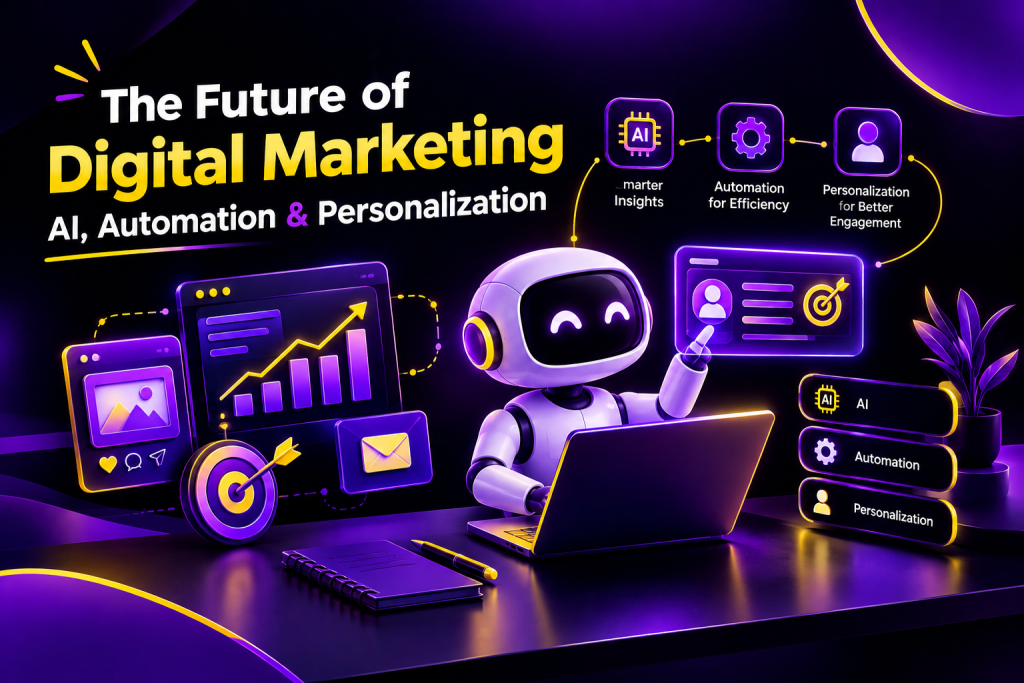
Future of Digital Marketing: AI, Automation & Personalization

How Is Digital Marketing Changing? Describe how digital marketing is evolving from traditional marketing toward the use ofdata-based decision making real-time customer exchanges,automated business processes,personalization,AI-driven content,predictive analytics,andmultichannel marketing in simple language. Make a brief statement showing how a business could use multiple channels to market its products. The Role of AI in the Future of Digital Marketing Describe how AI can help marketers with: Content creationCustomer insightsSearch optimizationAdvertisingData analysisAudience segmentationCustomer supportCampaign optimization Make it clear that AI is a tool that augments the marketing team, and not an immediate replacement for human creativity, strategic thinking, judgment, and brand savvy. H3: AI-Powered Content Creation Explain how AI can help marketers to create: Blog ideasContent outlinesSocial media ideasEmail draftsProduct descriptionsAd variations And note that human oversight, fact-checking, editing, originality, and brand voice are still vital to the process H3: AI-Powered Customer Insights Explain how AI can help analyze large marketing data sets to uncover trends, audience preferences, and customer behaviors. H3: AI in Advertising Explain how AI can help with: Audience targetingAd variationsCampaign analysisBudget optimizationPerformance insightsBut refrain from making unsupported claims about improved advertising effectiveness. H2: The Growing Importance of Marketing Automation Explain what marketing automation is in simple terms. Marketing automation refers to using different software and technology to automate and streamline marketing tasks. Explain how marketing automation can benefit organizations by providing: Email campaign automationLead nurturingCustomer segmentationSocial media marketingFollow-up emailsAutomated notificationsReportingWorkflow managementH3: Benefits of Marketing Automation Discuss: Time-savingReduced drudgeryConsistencyImproved lead-nurturingMore agilityEnhanced organizationH3: Examples of Marketing Automation Give some examples of marketing automation. For instance, a customer subscribes to a website, gets a thank you email, gets valuable content, gets an offer, and gets a follow-up message. The key point is to personalize the buyer’s journey based on their needs and the timing of their purchase. Why Personalization Is the Future of Customer Experience Explain personalization in simple language. Show the difference between Generic marketing and Personalized marketing Explain how personalization can use information such as interests previous interactions purchase history website behavior content preferences audience segments in order to make marketing communication more relevant. H3: Personalized Email Marketing Explain how businesses can personalize subject lines content recommendations offers timings H3: Personalized Website Experiences Explain how websites can provide more relevant content, recommendations, or messages based on visitor behavior where appropriate. H3: Personalized Advertising Explain how businesses can create different advertising messages for different audience groups. AI + Automation + Personalization: A Powerful Combination Explain how the three technologies work in tandem. Use the following format in your example: AI understands data Automation delivers relevant actions Personalization makes the experience more relevant. Show how one business could use all three technologies at various stages in the consumer journey. Use the following structure in your example: A customer visits the website Insight is gained on the customer AI identifies content or demographic information Automation provides a relevant communication Something is personalized Analytics is used to analyze the response. Future Digital Marketing Trends to Watch Discuss important trends that businesses should watch out for. Make sure to include: H3: AI-Powered Search and Marketing Explain how AI is changing the way searches are done and how discovery happens. H3: Conversational Marketing Chatbots, AI-assisted conversations and similar approaches fall under this category. H3: Predictive Marketing Explain how businesses can use data and AI to identify potential patterns and behaviors among customers. H3: Hyper-Personalization Explain how marketing can become more finely-tuned to different segments and contexts. H3: Automated Content Workflows Explain how businesses can use AI and automation to aid in the creation, planning, publishing, scheduling, and analysis of content. H3: Data-Driven Decision Making Explain why companies will be relying more on data and analytics to make marketing-related choices. Avoid presenting these as certainties. Benefits of AI, Automation & Personalization for Businesses Explain the key benefits, including: Greater efficiency,shorter marketing cycles,more relevant customer experience,optimized marketing data,increased productivity,consistently branded communication,improved customer understanding,andgreater marketing scalability. Explain that results vary based on implementation, strategy, data quality, and business objectives. Challenges Businesses Need to Consider Do not suggest that AI and automation is always a positive and perfect solution. Make sure to address challenges like H3: Data Privacy by discussing why businesses should be responsible with customer data H3: Maintaining Human Creativity by explaining why human creativity, imagination, storytelling, empathy, and strategy should not be lost, H3: Accuracy and Quality by explaining why AI produced content should be well-researched and factually accurate, H3: Over-Automation by describing how automation can lead to impersonal and unempathetic communication, H3: Choosing the Right Technology by explaining companies should invest in the technology that addresses their specific business needs and not simply adopt the latest trends. How Businesses Can Prepare for the Future of Digital Marketing? Offering a real-world perspective. H3: Step 1 — Know Your Customer Inside Out Motivate the businesses to research their customer base and understand their demands and behaviors. H3: Step 2 — Develop a Strong Digital Presence Include such subheadings as create a website, SEO and content marketing, leverage social media, analyze data, and enhance customer experience. H3: Step 3 — Begin with Small and Straightforward AI-Driven Tasks Advise businesses to invest in simple and effective AI-driven automation rather than attempt to digitize their whole operation at once. H3: Step 4 — Automate Everything That Can Be Automated Explain what repetitive and monotonous tasks can be substituted by AI-driven automation tools to make the operation more efficient. H3: Step 5 — Use Personalization Wisely Remind the readers not to overlook the importance of personalization, which is critical for engaging and retaining clients. H3: Step 6 — Measure and Optimize Frequently Asked Questions (FAQ) 1.What is the future of digital marketing? The future of digital marketing will focus more on AI, automation, personalization, data-driven strategies, and better customer experiences. Businesses will increasingly use technology to understand their audiences and create more relevant marketing campaigns. 2. How is AI changing digital marketing? AI is helping marketers analyze data, create content, understand customer behavior, optimize advertising, improve SEO workflows, and provide faster

Uncategorized

Digital Marketing AI Marketing Guide AI Marketing for Small Businesses: A Complete Guide A practical, no-jargon walkthrough of how small businesses can use AI to save time, cut marketing costs, and compete with bigger brands — without losing the human touch. Meta Title AI Marketing for Small Businesses: A Complete Guide Meta Description Learn how AI marketing for small businesses works, its benefits, tools, and a step-by-step strategy to save time and grow smarter. URL Slug /ai-marketing-for-small-businesses Primary Keyword AI marketing for small businesses Secondary Keywords AI marketing AI in digital marketing AI marketing tools AI tools for small businesses AI content creation AI social media marketing AI email marketing AI SEO tools marketing automation AI customer service Running a small business means wearing a dozen hats at once. You are the founder, the salesperson, the customer support line, and — more often than not — the marketing team too. Budgets are tight, time is tighter, and it can feel impossible to compete with larger brands that have entire marketing departments behind them. This is where AI marketing for small businesses is starting to change the game. Artificial intelligence tools can now help you write content, understand your customers, automate repetitive tasks, and market smarter — even with a small team and a limited budget. In this guide, you’ll learn what AI marketing actually means, why it matters for small businesses, how to use it across content, social media, email, SEO, and customer service, and how to build a simple AI marketing strategy of your own. What Is AI Marketing? AI marketing simply means using artificial intelligence tools to plan, create, and manage your marketing activities. Instead of doing every task manually, AI software helps you work faster and smarter. At its core, AI in digital marketing can help a business: Understand customers by analyzing behavior and preferences Create content such as social posts, emails, and blog ideas Automate repetitive marketing tasks like scheduling and follow-ups Analyze marketing data to spot patterns and opportunities Personalize communication for different customer groups Improve overall marketing efficiency Here’s a simple example: imagine a local bakery that wants to send a weekly email newsletter. Instead of spending hours writing it from scratch, the owner can use an AI writing tool to draft the email, then review and personalize it before sending. What used to take two hours might now take twenty minutes. Why Should Small Businesses Use AI Marketing? AI marketing isn’t just for big companies with big budgets. For small businesses, it can be even more valuable because it helps you do more with less. Saves Time AI can handle repetitive tasks like drafting social captions, organizing customer data, or scheduling posts. This frees up hours each week that you can spend on strategy, sales, or serving customers directly. Reduces Marketing Costs Instead of hiring a large team to cover every marketing task, AI tools let a small team — or even a single person — handle content, SEO, and outreach more efficiently, stretching a limited budget further. Helps Create Content Faster AI marketing tools can assist with blog ideas, social media captions, email drafts, and product descriptions. This is especially helpful for businesses that struggle to post content consistently. Improves Customer Understanding AI can help analyze customer behavior, purchase patterns, and engagement data, giving small businesses insights that were once only available to larger companies with dedicated analytics teams. Supports Personalized Marketing With AI, businesses can create more relevant messages for different customer segments — for example, sending different offers to first-time buyers versus repeat customers. How Can Small Businesses Use AI in Marketing? AI marketing tools can support almost every part of your marketing, from content to customer support. Here’s how it breaks down in practice. AI for Content Marketing AI content creation tools can help generate blog ideas, content outlines, social media captions, product descriptions, and even repurpose one piece of content into multiple formats. This is a huge time-saver for businesses without a dedicated writer. Important: always review and edit AI-generated content before publishing. AI can give you a strong starting point, but your brand voice, accuracy, and personal touch still matter. AI for Social Media Marketing AI social media marketing tools can suggest content ideas, write captions, plan posting schedules, and offer basic audience insights. Some tools can also help repurpose a single video or blog post into several social formats. AI for Email Marketing AI email marketing tools can help write subject lines, draft email copy, personalize messages based on customer data, and segment your audience into groups so the right message reaches the right people. AI for SEO AI SEO tools can support keyword research, content outlines, search intent analysis, and on-page optimization suggestions. AI should support your SEO work, not replace human judgment — search intent and quality still need a human eye. AI for Customer Support AI customer service tools like chatbots can answer common customer questions instantly, freeing up your time while still giving customers fast responses, even outside business hours. Best AI Marketing Tools for Small Businesses Rather than chasing every new app, it helps to think in terms of tool categories and what each one solves for: AI writing tools — for blog drafts, captions, and email copy AI design tools — for quick graphics, social visuals, and simple branding assets AI SEO tools — for keyword research and content optimization suggestions AI analytics tools — for understanding website traffic and customer behavior AI chatbot tools — for automating common customer questions AI email marketing tools — for drafting, segmenting, and personalizing campaigns AI automation tools — for connecting your apps and automating repetitive workflows When evaluating any tool, check what it actually does, how it fits your budget, and whether it fits naturally into your existing workflow — rather than relying on unverified claims about specific features or pricing. How to Create an AI Marketing Strategy for Your Small Business Step 1 — Define Your Marketing Goal Decide what

Uncategorized

On Page SEO Off Page SEO: What’s The Difference?

What Is On-Page SEO? What is On-Page SEO? It is a type of SEO focused on optimizing the content and elements which are on your site. It makes your pages easier to read and understand by search engines, as well as regular internet users. You have full control over most of the On-Page SEO factors, including the content itself, headings, title tags, URL, images, and internal links. Elements of On-Page SEO 1. Keywords They are terms or phrases which people type into search engines. Proper use of keywords makes content more understandable for users and search engines. A digital marketing agency may have keywords like ‘digital marketing services,’ ‘SEO services,’ or ‘social media marketing.’ However, spammed keywords can make your content look spammy. 2. Title Tags A title tag is used by the search engine to identify a web page’s content. Moreover, it helps users to understand what is a specific web page about. Hence, an informative title tag is essential for the proper optimization of a web page for search engines. For instance, On-Page SEO vs. Off-Page SEO: Complete Guide 3. Headings and Subheadings The use of H1, H2, and H3 tags in a web page’s code helps to optimize a page and arrange its content in a hierarchical manner. It makes a page easier to read and helps the search engine crawl a website faster. 4. High-Quality Content Content creation is the most important and informative part of On-Page SEO. It is vital to create content that answers the users’ questions and provides them with the necessary information regarding a specific topic. Moreover, it is important to optimize content to fulfill search intent rather than optimize it for search engines. 5. Internal Linking Internal links are used to connect one web page to another. For example, a blog about SEO may contain an internal link to the company’s SEO service page. The connection of web pages using internal links helps users to find the information that they are looking for and helps search engines to index a website faster. 6. Image Optimization Images on a website should also be optimized for a better user experience and to improve a website’s SEO. Optimizing an image may include several optimization techniques, such as adding relevant image file names, image sizes, and image alt text. What Is Off-Page SEO? Off-Page SEO refers to activities performed outside one’s website that can aid the optimization of a site. Unlike On-Page SEO, the influence of the 3rd party on Off-Page SEO activities is very high. Important elements of Off-Page SEO include: 1. Backlinks Backlinks are links from another site to the site. Although a higher number of backlinks indicates a higher level of popularity of webpages, in terms of SEO, backlinks must possess specific weight and trust. Hence, although backlinks contribute to the increased visibility of a site, attention should be paid to their relevance and quality instead of quantity. 2. Digital PR Digital PR is a practice of increasing awareness about a particular company, product, or brand through publication on relevant websites. Online articles, mentions, and various types of publications, including press releases, may improve a website’s visibility and popularity by creating higher levels of trust and brand recognition among users. 3. Brand Mentions Brand mentions are mentions of the brand name in media resources. They refer to different types of mentions, which can be found in online publications and stories, product listings, business directories, and social media. They play a vital role in SEO since they promote a brand and increase its visibility in the media. 4. Social Media Promotion In terms of social media, the primary element is social sharing. Though social media links do not directly impact a website’s ranking, they help in generating awareness and increasing the entry points for potential website visitors. Hence, such entry points contribute to increased visibility and engagement and provide an opportunity for referral traffic and mentions. 5. Local SEO Activities Local SEO Activities refer to optimizing the entries of a company in local listings. Though local listings do not have a significant impact on SEO, they help in increasing a company’s visibility in local searches. On-Page SEO vs. Off-Page SEO: Key Differences Table Header FACTOR ON PAGE-SEO OFF PAGE-SEO Content Content Why Do You Need Both On-Page and Off-Page SEO? Choosing between on-page and off-page SEO optimization is generally not advisable. A balanced SEO strategy would involve both. Consider that you have already composed a high-quality web page with optimized media, structure and content. Even so, low general awareness or authority of your site may prevent it from appearing in the search engine results pages. Simultaneously, the presence of external references and promotion can entice visitors, but without corresponding website resources and optimization, they will not bring significant results. The Canonical SEO Optimization Cycle An effective SEO campaign can be organized in the following manner: 1. Foundational optimization: This step involves the improvement of the website infrastructure and content. 2. Useful content generation: The next point is the creation of informative resources that will help you attract the desired audience. 3. Internal network expansion: At this stage, site visitors should be able to navigate your website easily and access all the materials offered. 4. Authority construction: Following that, it is critical to increase the appeal of your site and encourage third-party linking and referencing. 5. Analytical accounting: Finally, SEO data should be analyzed and examined to identify weak points and optimize the strategy. Which Is More Important: On-Page SEO or Off-Page SEO? On-page SEO and off-page SEO are two separate concepts; hence it is better to consider them as supplementary elements. On-page SEO practices help to optimize internal elements so that search engines can easily read website contents and enable users to find the exact information they are looking for. Meanwhile, off-page SEO refers to optimizing the site’s authority to ensure that it appears in search results. However, to achieve the best results, it is essential to combine on-page SEO and off-page

Uncategorized

Social Media Marketing Trends Every Business Should Follow In 2026

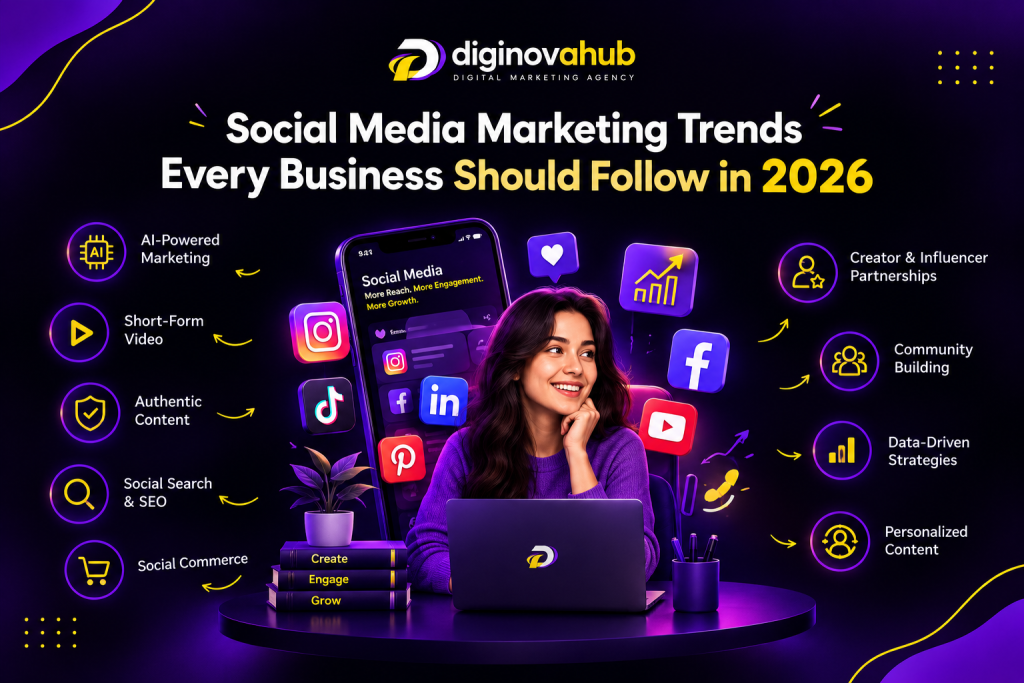
1. AI-Powered Social Media Marketing Technology of Artificial Intelligence (AI) is increasingly being used as a strategic tool by digital marketers. In 2026 companies will employ AI to make social media marketing more effective. AI can be utilized in many marketing areas like developing content ideas, analyzing audience data, learning performance insights, creating content drafts, and improving campaign planning. However, there is one major disadvantage that AI cannot replace humans and their creative process. Customers appreciate original and valuable content that is relevant to them and the company’s brand. 2.How Businesses Can Use AI Generate ideas for social media contentDiscover relevant topics and trendsAnalyze the effectiveness of your campaignsGet to know your audience’s interestsCreate variations of your contentEnhance your social media planning The most effective method is to combine artificial intelligence and human creative ability and brand knowledge. Short-Form Video Will Continue to Grow Short-form videos continue to be one of the most important content formats for social media marketing. Social networks such as Instagram, YouTube, TikTok, and others have made short videos an important tool for connecting with customers. Businesses do not always need to invest heavily in production; even simple, useful, and entertaining videos can effectively convey information to the target audience. H3: Short-Form Video Ideas for BusinessesAmong the many options that companies have when creating promotional videos, the following options seem the most attractive:demonstration of products, short guides and tips,behind-the-scenes look,experience with customers,answers to questions,advice from experts,comparisons of before and after,and educational materials. Authentic and Human Content Nowadays, people have become more aware of heavily edited and exaggerated content. Being authentic in 2026 is an essential aspect of social media. Social media accounts can depict their employees, the inner workings of the company, company culture, users’ experience, and the employees’ experience. It does not mean that brands should not be casual, but rather act natural and true to themselves, in a way only they can. H3: Why authenticity helpsAuthentic content allows businesses to build trustestablish relationships display their personalities engage in discussions and be more memorable. . Social Search and SEO Are Becoming More Important People are increasingly turning to social networks for finding information, products, businesses, and more. Therefore, social media SEO is an essential part of any modern social media strategy. The companies must use the long tail of keywords in their captions, profile descriptions, video titles and descriptions, and elsewhere to improve their discoverability by both people and search algorithms. How to Improve Social Media SEO Use keywords in your contentCreate informative captions for your postsOptimize your social media profilesUse descriptive titles for your videosUse hashtags on your social media postsAnswer frequently asked questionsCreate content based on popular topics Social media is an important marketing channel and cannot be ignored as part of your overall SEO strategy. Social Commerce Will Create More Buying Opportunities Social media is becoming increasingly intertwined with retail purchases. Consumers are becoming familiar with a product on social media before visiting the site of a particular retailer. Businesses can utilize product-oriented posts, videos, demonstrations, reviews, and other social commerce functions to improve the consumer experience and make the purchasing process more convenient. How Businesses Can Use Social Commerce Showcase products via videosHighlight benefits of productsUse customer reviewsProduce educational content about productsMake it easy for users to discover productsSteer users toward product purchase options…… Creator and Influencer Partnerships Choosing the Right Creator Influencer marketing is a continuously growing field; however, sometimes it is not necessary to work with someone who has enormous popularity and millions of followers. Micro-influencers who have an active community of people interested in their content can also help promote a business if their audience matches the target group. Before contacting a specific creator, you may want to do some research on:their audience,content style,engagement,relevance to the industry,brand fit,and previous collaborations A successful     collaboration should feel organic and authentic rather than forced or disguised as an advertisement. Community Building Over Just Follower Growth Having a couple of thousand followers does not necessarily mean that a person has a considerable presence on social media. Companies need to focus on increasing their community’s size and engagement in 2026. Engagement means responding to comments, answering questions, asking for feedback, and inviting to discussions. H3: Ways to Build Your Community Using questionsAnswers to commentsPolls and interactive postsStories of customersUser-generated contentHelpful content: educational or entertainingConversational commerce: customer support and interaction Data-Driven Social Media Strategies Successful social media marketing should not be based on guesswork about what your target audience wants Companies need to analyze their performance to see what changes they can make to their marketing mix The key performance indicators (KPIs) should be reached, such as sales, number of customers, website visits, impressions, clicks, engagement, and others. What Should You Measure? Depending on your goals, you can track such metrics as reach and impressions,engagement,video views,link clicks,website visits,leads,conversions,and return on ad spend for your paid social media campaigns. Personalized Content Will Stand Out People come across a lot of information on a daily basis. Generic content can often get overlooked Content tailored for a specific audience appeals to certain demographics and fits their needs and concerns. Say a company specialized in travel, they could create a variety of content pieces for families, students, couples, and business professionals instead of basing all of their content around a generic idea. The more relevant the information is for the audience, the more appeal it will have How to Build a Social Media Strategy for 2026 Following trends is good, however not following everything that is trendy is also good for a business. A strong strategy always begins with defining a goal. H3: Step 1 — Define Your Goal Define what success looks like to you. A brand or business needs to decide on a specific and achievable purpose for the social media efforts, e. g. building awareness, driving traffic, gaining leads or sales, or engaging customers. H3: Step 2 — Understand Your Audience Know who your customer is, what they might be interested in, what

Scroll to Top