
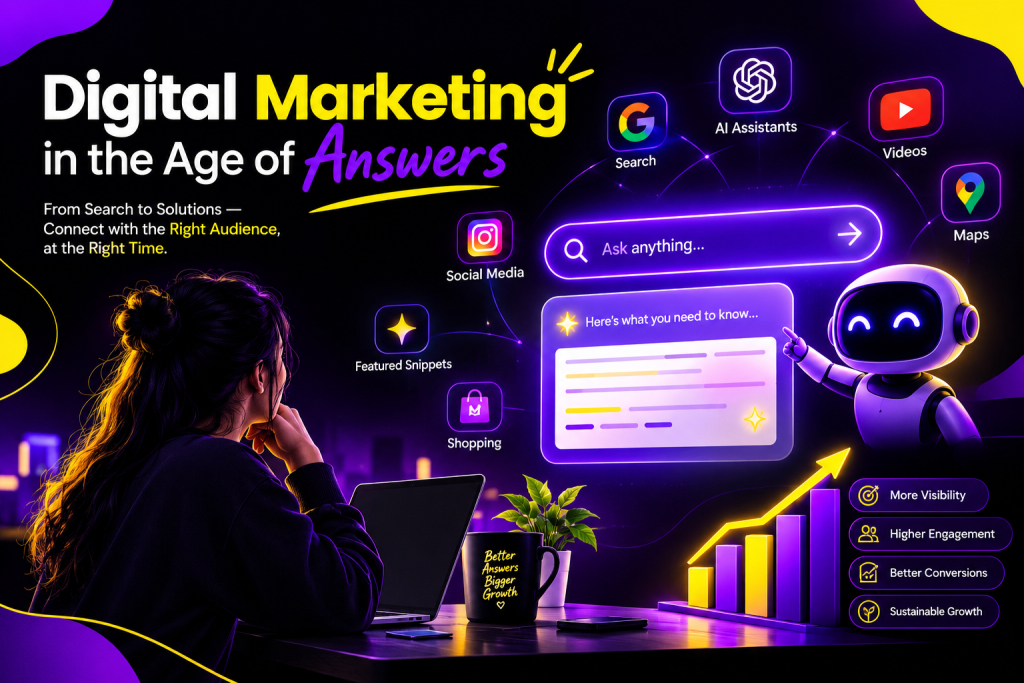
Digital Marketing in the Age of Answers
Digital Marketing in the Age of Answers The way in which people search for information on the web is rapidly evolving. There is a growing trend in which searchers ask natural language questions that are answered directly by AI search tools instead of having to sift through a list of results to find relevant resources. This phenomenon is what we refer to as the Age of Answers. What this means for marketers is that optimizing your website so that it shows up higher on the search engine results page is no longer enough. You must be able to provide search engines and customers with information that is easily understood and acted upon. From SEO and content marketing to social media and AI optimization, discover all the ways in which digital marketers need to adapt in this era of answers. In this blog, we will discuss the impact of the age of answers on digital marketing. What Is the Age of Answers? The Age of Answers describes a search environment where users increasingly expect direct, useful answers to their questions. Traditional search usually works like this: User searches → Search engine shows links → User visits websites → User finds an answer AI-powered search can change the experience: User asks a question → AI understands the query → AI generates or summarizes an answer → User may explore supporting sources This does not mean traditional search has disappeared. Instead, search is becoming more conversational, contextual, and answer-focused. For businesses, the important question is no longer just: “How do I rank on Google?” It is also: “How can my brand become a trusted source for answers?” How AI Is Changing Digital Marketing Artificial intelligence is set to revolutionize every element of digital marketing. From analyzing information to studying the audience, generating content ideas, automating repetitive tasks, personalizing the experience and recognizing patterns, AI can help marketers in so many ways. Search is also moving towards more conversational interfaces where users are asking questions rather than just typing in a few words. Instead of searching for something like: “best digital marketing agency” users could ask the following question: “What should a small business look for when choosing a digital marketing agency?” This means that there are exciting opportunities for companies that can produce high quality, comprehensive and trustworthy content. From Keywords to Questions Traditional SEO often focuses heavily on keywords. Keywords remain important, but marketers should also understand the questions and problems behind those searches. Instead of creating content only around a keyword, businesses should answer: What is the user trying to understand? What problem are they trying to solve? What follow-up questions might they have? What information would help them make a decision? This approach can make content more useful for both people and modern search systems. Why SEO Still Matters in the Age of Answers The rise of AI does not make SEO irrelevant. Because SEO helps search engines to find, understand and evaluate the content of a web page. Moreover, proper SEO practices allow you to shape the desired perception among customers. The main directions of SEO are: Helpful and relevant content Search intent Clear website structure Internal linking Descriptive titles and headings Technical SEO Mobile-friendly design Page experience Accurate and updated information Relevant authority and references The difference is that SEO is becoming broader. Businesses need to think beyond traditional rankings and consider how their information may be discovered across different search experiences. The Rise of Answer Engine Optimization Answer Engine Optimization (AEO) focuses on making content easier for systems that provide direct answers to user questions. The goal is not simply to rank for a keyword. It is to provide information that clearly answers a user’s question. H3: How to Optimize Content for Answers Businesses can improve answer-focused content by: Answering questions directlyGive a clear answer before adding deeper explanations. Using descriptive headingsOrganize content around meaningful questions and topics. Adding useful examplesExamples make complex concepts easier to understand. Using structured informationLists, tables, steps, and clearly organized sections can improve readability. Building topical depthCover the main topic and closely related questions comprehensively. Keeping information accurateReview and update content when facts, products, or industry practices change. Content Marketing in the Age of Answers Content marketing is shifting its focus toward helpfulness and expertise. Publishing vast amounts of generic content is no longer sufficient in and of itself. Firms must create content that actually helps people and instills confidence in their brands. Useful forms of content include: How-to guides Detailed blog posts FAQs Case studies Comparison articles Original research Tutorials Expert insights Checklists Industry reports For example, instead of writing a general article titled “What Is SEO?”, a business could create a comprehensive guide explaining how SEO works, common mistakes, practical examples, and frequently asked questions. Create Content That Deserves to Be Cited In an answer-focused search environment, businesses should strive to create informative, helpful, credible and well-researched content, wherever appropriate. Original insights, first-hand research and expert opinions, along with examples and credible references, will help businesses create the most value from their content. The basic idea is simple: Don’t create content for the sake of ranking, but rather create content worth finding. Brand Visibility Is Becoming More Important In traditional search, a user typically sees several sites (in search engine result pages) and then goes to a site. In an AI powered search experience, the user may see a summary of an answer that may include or credit multiple sources. This means brand presence and visibility matters even if a user isn’t clicking through to a site. Businesses need to work across channels to build their presence including: Websites Search engines Social media Business profiles Industry websites Review platforms Video platforms Online communities A strong and consistent digital presence can help people recognize and trust a brand across different discovery channels. H2: How Businesses Can Adapt to the Age of Answers Businesses do not need to completely abandon traditional marketing strategies. Instead, they should expand them. H3: