Google Ads

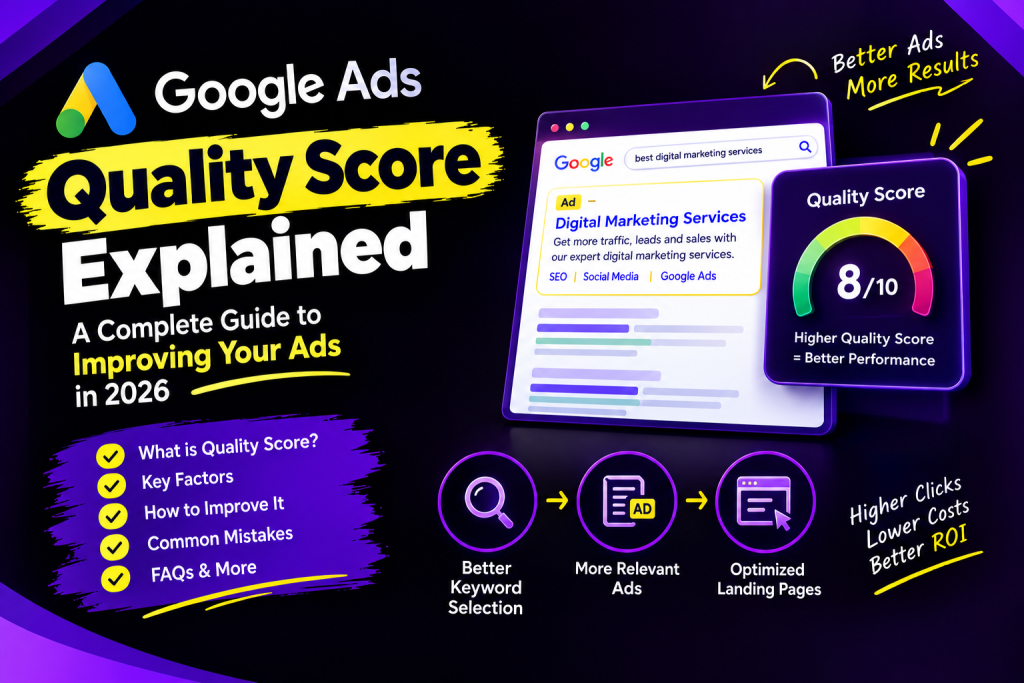
Google Ads Quality Score infographic showing key factors, ad relevance, landing page optimization, and tips to improve ad performance.
Google Ads

Google Ads Quality Score Explained: A Complete Guide to Improving Your Ads in 2026

Google Ads Quality Score Explained Google Ads is one of the most popular online advertising platforms that allow organizations to bid on search terms and place their ad copy in front of the target audience. Yet, bidding on keywords and designing catchy headlines and text isn’t enough. One should take into account that the created advertisement should be relevant and match the landing page that appears after clicking on the ad. The main key performance indicator (KPI) that shows how successful the Google advertising campaign is by comparing it to the average Quality Score of similar ads in the auction is Google Ads Quality Score. Essentially, this metric evaluates the relevance of advertisements, keywords, and landing page. Understanding the scoring system and learning how to improve it is essential in getting the best possible score. This guide will discuss what Google Quality Score is, how it works, factors that influence it, and the best practices to boost it. What Is Google Ads Quality Score? Google Ads Quality Score is a diagnostic metric that rates the quality of your keywords and related advertising experience on a scale of 1 to 10. Google calculates this keyword-level score using three main components: Expected click-through rate (CTR) Ad relevance Landing page experience Each element may be graded as Below average, Average, or Above average. Quality Score assists the advertisers in the comparison of their ads on the basis of the same search terms with others’ advertisements. It should be remembered that Google considers this score as a diagnostic instrument and not as an input for the auction process directly. For instance, if your keyword’s score is 4 out of 10, you should take a close look at the expectation of CTR, ad relevance, and landing page. It is not essential to aim for the highest score, but it is critical to make your advertisement relevant and beneficial for the customers. Why Is Google Ads Quality Score Important? Quality score helps in understanding how well the keywords, ads, and landing pages rank together to meet the expectations of users. H3: 1. Helps Recognize Issues With Advertising A low score may indicate that the advertisement lacks strong relevance to the search term or that the landing page is unsatisfactory. By analyzing all three factors, one can easily detect which element requires optimization. Otherwise, if the quality score is high, this means that no changes are necessary. H3: 2. Enables More Relevant Advertising High relevance is one of the most significant advantages provided by quality scores. In case of proper organization, the advertisement will have a better chance of appearing when users search online using specific keywords. Moreover, the ad will address their queries more specifically, which means that the customers will find exactly what they are looking for. H3: 3. Enhances Landing Page Experience A high-quality landing page enables the user to receive the information that they need quickly and easily. First of all, it should be visually appealing so that the customer would not leave it immediately after opening. Secondly, it should contain valuable content and be easy to navigate. It goes without saying that the faster the page opens and the more useful information it provides, the more satisfied the user will be. H3: 4. Allows Optimizing the Campaign As has been mentioned above, quality score serves as a basis for optimizing the keywords, ads, and landing pages. However, even though it may boost the campaign’s performance, it does not guarantee any specific results such as reduced cost per click or increased conversion rate. What Are the Three Main Factors of Google Ads Quality Score? Expected CTR estimates how probable it is that your ad will get a click for the specific keyword. It is based on data about how Google’s algorithm is likely to react to the queried term independently on its position and other factors. An appealing ad with a good match to the search term can entice users to click on it. How to improve expected CTR: Write clear and engaging headlines. Match your ad message to the keyword. Explain the main benefit of your product or service. Use relevant calls to action. Add suitable assets, such as sitelinks, when helpful. Avoid misleading promises or unrelated messages. Example: If someone searches for “SEO services for small businesses,” an advertisement that clearly offers SEO services for small businesses is more relevant than a generic advertisement about digital marketing. Ad Relevance Ad relevance measures how closely your advertisement matches the intent behind a user’s search. If your keywords, headlines, descriptions, and offer are connected, your advertisement can provide a more useful experience. How to improve ad relevance: Organize keywords into closely related ad groups. Write ad copy that matches the keywords in each group. Include relevant terms naturally in headlines and descriptions. Make the advertised offer clear. Avoid placing unrelated services in the same ad group. Ensure the ad accurately describes the landing page. Example: Suppose you run a campaign for website development services. An ad group targeting “WordPress website development” should contain ads focused on WordPress development rather than unrelated services such as email marketing. This makes the relationship between the keyword and advertisement clearer. H3: 3. Landing Page Experience Landing page experience evaluates how useful and relevant your landing page is for people who click your ad. Even a well-written advertisement may perform poorly if the destination page is confusing, slow, difficult to use, or unrelated to the search. How to improve landing page experience: Make sure the page matches the advertisement. Provide the information promised in the ad. Improve page loading speed. Make the page mobile-friendly. Use clear headings and readable content. Make contact forms and buttons easy to find. Avoid intrusive pop-ups. Keep important information accurate and easy to access. Example: If your advertisement promotes Google Ads management, the landing page should explain your Google Ads service, its benefits, your process, and how customers can contact you. Sending visitors to an unrelated homepage may create a less helpful

Google Ads

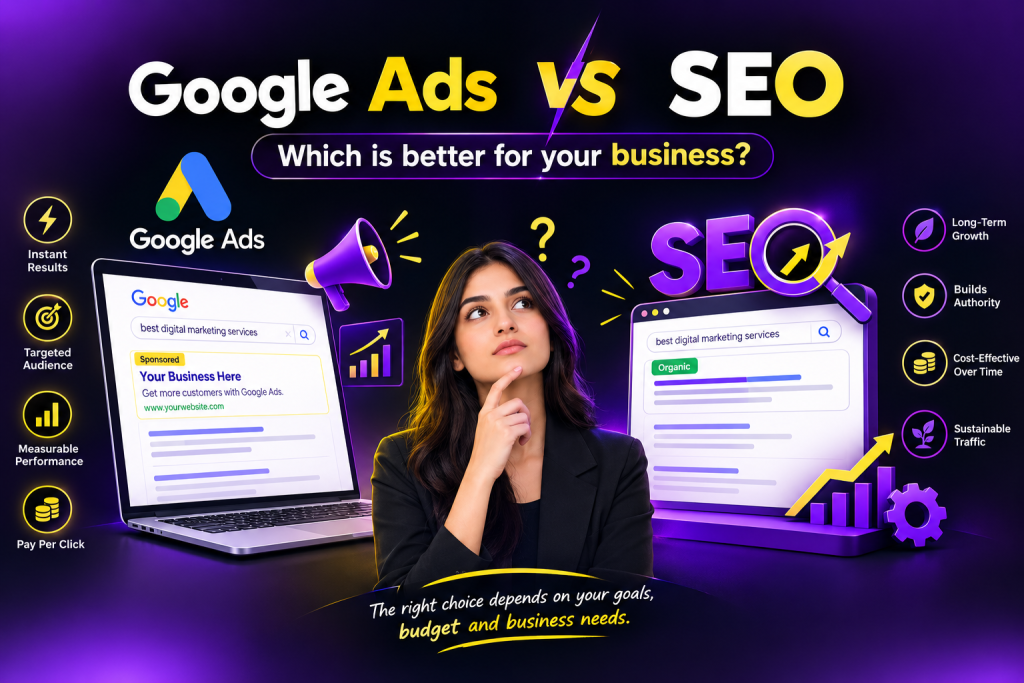
Google Ads vs SEO: Which is better for your bussiness?

Google Ads vs SEO: Which Is Better for Your Business? In the contemporary digital age, businesses must invest significantly in their online presence to sell products and services conveniently and attract new customers. Two popular options for improving a company’s visibility on Google are Google Ads and Search Engine Optimization. However, which of these two is more advantageous to a business? The answer depends primarily on the company’s objectives, budget, the level of competition in its area, and the speed with which it wants to see results. Google Ads allows companies to appear prominently in search results by paying for the placement of links, images, video, or text ads. SEO refers to optimizing a website’s content and structure so that it appears in search results for specific queries without additional payment. In this article, we will compare Google Ads and SEO and highlight the advantages and disadvantages of each. What Is SEO? Search Engine Optimization (SEO) is the process of improving your website so that it can appear higher in organic search results on search engines like Google. SEO focuses on different areas, including: Keyword optimization High-quality content Website structure Technical SEO On-page SEO Off-page SEO Backlinks Mobile optimization User experience For example, if you own a digital marketing agency and optimize your website for the keyword “digital marketing agency in India,” your goal is to make your website appear in Google’s organic results when people search for that term. How Does SEO Work? Unlike many other marketing areas, SEO usually presupposes some knowledge of what exactly your target audience is searching for and what kind of information and services they are looking for. Since search engines consider a plethora of different criteria, one cannot just stuff a site with keywords in order for it to appear in search results. SEO requires good quality, informative and relevant content, which would be easy to find, navigate and cite. What Are Google Ads? Google Ads is Google’s online advertising platform through which businesses can pay to advertise their products and services on Google’s advertising network. By using Google Ads, businesses can advertise specific: KeywordsLocationsAudiencesDevicesSearch queriesInterests An example of an advertisement using Google Ads would be for a business offering Website Development services. Such a business could create an advertisement targeting keywords like “Website development company” or “Web development services.” The moment a client searches for one of these targeted terms, a relevant ad can show up prominently in search results. Google Ads vs SEO: Key Differences Although both strategies can help businesses attract customers from search engines, they work differently. Factor Google Ads SEO Traffic Type Paid Organic Results Usually faster Usually slower Cost Pay for advertising Investment in SEO work/content Long-Term Value Requires ongoing ad spend Can provide lasting organic visibility Control High control over targeting Less direct control over rankings Testing Easy to test campaigns Takes more time to evaluate Competition Higher bids can affect costs Competitive rankings can take time Best For Quick traffic and conversions Long-term growth Benefits of Google Ads H3: 1. Faster Results One of the major benefits of Google Ads is speed. Once your campaign is set up and running, you start getting impressions and clicks almost immediately. Google Ads is therefore a great fit when you need to advertise a new product, service, offer, or event. H3: 2. Target the Right Audience With Google Ads, there are multiple ways of targeting the exact audience you want to reach out to. From location targeting to keyword and audience segmentation, the platform offers you a variety of options that let you narrow down on the most relevant group of potential customers. This means you don’t waste your money on everyone, just the most qualified leads. H3: 3. Measurable Results With Google Ads, every penny you spend is measurable. In fact, the platform gives you a lot of data at your disposal to see what your campaigns are and where they can be improved. The following are some of the most important metrics that you can analyze and use to tweak your campaigns: • Number of clicks • Number of impressions • Number of conversions • CTR (click-through rate) • Cost per click (CPC) • Cost per conversion H3: 4. Target Your Money-Making Keywords If you’re going after keywords that are highly competitive and it’s taking too long to rank for them, then Google Ads can buy you time while you continue working on your SEO. Benefits of SEO H3: 1. Long-Term Visibility SEO or search engine optimization helps websites appear in natural search results by constantly providing useful information and following specific rules. If the page is optimized correctly, it will continue to attract for as long as the website is operational without spending money on each surfer. H3: 2. No Dependence on Paid Promotion At the same time, one should understand that to maintain organic traffic, one needs to invest heavily in SEO. Unlike paid promotion, which only requires a budget to be allocated to пpc advertising, SEO requires ongoing investment in content, coding, research, and optimization. H3: 3. Authority Building SEO also allows you to build authority by providing useful and relevant content that people are looking for. This will increase the authority of the page and, as a consequence, its visibility in the search engine. H3: 4. Growth Leverage SEO is often the cornerstone of a firm’s long-term growth strategy. SEO supports the conversion lifecycle at different levels: from educating the consumer about the problem to comparing potential solutions and facilitating the final purchase decision. Google Ads vs SEO: Which Is More Cost-Effective? The answer is based on what your business needs. With Google Ads, as a rule, you pay for advertising traffic – that is, for clicks or specific actions on your website, depending on the campaign type; and the cost depends on how much money you spend on promoting your business on Google. At the same time, with SEO optimization, you pay for the development and optimization of your site

Google Ads

Google AI Mode & What It Means for Your SEO in 2026

Google AI Mode & What It Means for Your SEO in 2026 Search is evolving. Users are no longer interested in simply plugging a few words into Google and clicking on the first link that appears. They are searching for more in-depth answers to their specific questions. In addition to the usual Google search, a significant trend is Google AI mode. Google AI mode is an innovative AI-powered Search experience that is designed to help users find more comprehensive answers to their queries. It is intended for complex questions, follow-up exchanges, and deeper exploration of the world’s information. As of 2026, Google has enhanced its capabilities to continue its improvements in AI-powered Search and to further enrich the discovery of websites and content on the web. What does this evolution of search mean for SEO? Does SEO suddenly become irrelevant? The answer is no. However, SEO tactics must now shift to emphasize the importance of content that is not only SEO optimized but also informative and well-structured. What Is Google AI Mode? Google AI Mode is an AI-powered Search experience that lets users ask more complex and conversational questions. Instead of searching for a few stand-alone keywords, users can ask one detailed question and then follow-up with additional questions to continue the conversation. For example, rather than searching: “best digital marketing strategy” a user could ask: “What digital marketing strategy should a small business use if they have a limited budget and want to generate leads online?” Google’s AI can decompose complex questions into related subtopics, and perform a search across multiple areas to create a more expansive view of the topic. Google refers to this as query fan-out. AI Mode can also work with different forms of input, including text, voice, and images. Google launched AI Mode in India in 2025, letting users ask questions, explore topics with follow-ups, and get links to relevant web content. Google AI Mode vs. Traditional Google Search Google AI Mode vs. AI Overviews What Are AI Overviews? AI Overviews can give you an AI-powered summary within Google Search for certain queries. They can help introduce a topic quickly, and will include links for further reading. What is AI Mode? AI Mode lets you go deeper into a more conversational search, and follow up on related queries. You may remember Google began testing different AI-powered search experiences, and recently began testing the ability to transition between them. In 2026, Google introduced a unified vision for an AI-powered Search experience, where users can move from an AI Overview into AI Mode, and follow links to related topics. Why Does This Matter for SEO? It implies that businesses need to think beyond targeting one keyword. Your content should be informative enough to answer questions and address related questions that your target audience will have. What Does Google AI Mode Mean for SEO in 2026? The growth of AI-powered Search does not spell doom for SEOs. Rather, it is a transition away from a narrow focus on content quality and relevance to a more holistic consideration of contextual appropriateness, search intent, website accessibility, and end-user requirements. Some trends that businesses should be aware of are as follows: Search Queries Are Becoming More Conversational It is now possible to ask Google more nuanced questions in a more natural language. Google announced in 2026 that, on average, an AI Mode query in the United States was three times longer than a regular Search query. As such, businesses should take advantage of this shift and focus on creating content around questions, rather than simply keywords. For instance, instead of just focusing on the keyword ‘SEO services’, a company could also create articles or web pages answering the question ‘how can SEO services aid a small business in gaining more website visitors?’ Long-Tail Keywords Are Becoming More Useful Examples may include: questions about improving your local SEO as a small business, the benefits of SEO for an e-commerce site, the best content marketing practices for a start-up, or ways to boost your website’s organic traffic. Your customers’ search queries will often tell you exactly what they are looking for. Therefore, it is vital to answer them truthfully and thoroughly to provide the best possible solution. Content Must Answer Real Questions One of the most common mistakes companies make is creating content for the sake of keywords. Ask yourself, Does this article actually help the reader? A good article should have explanations, examples, information, and answers to related questions. Google has also begun prioritizing connecting users with useful websites, original content, and first-hand experience in their AI Search features. How to Optimize Your Website for AI Search There is no secret sauce that can ensure that one’s website appears in AI-generated Search results. However, businesses can take a number of steps in order to improve their presence. Following the best SEO and content creation practices can improve the likelihood of getting discovered. Make the Articles Useful and Differentiating It is important to note that one should not write generic articles that do not offer any additional value. One’s articles should rather include one’s own advice, examples, research, case studies, experiences, expert opinions, and unique perspectives The more useful the article is for the reader, the more valuable it is. Understand Search Intent Before creating an article, learn to understand the query. A person searching for “what is SEO” would probably want a definition Someone searching for “SEO agency near me” is likely to click on the first result But a person searching for “SEO pricing for small businesses” might want a price comparison Understanding the intent behind a search can help us create articles that answer questions and solve problems. Use Conversational Keywords Naturally You don’t need to write awkward sentences in an attempt to include keywords. Instead, you can ask questions throughout your content. For example: H2: How Can Small Businesses Improve SEO? And then answer the question below it. That way, it’s much easier to both read and understand

Scroll to Top