
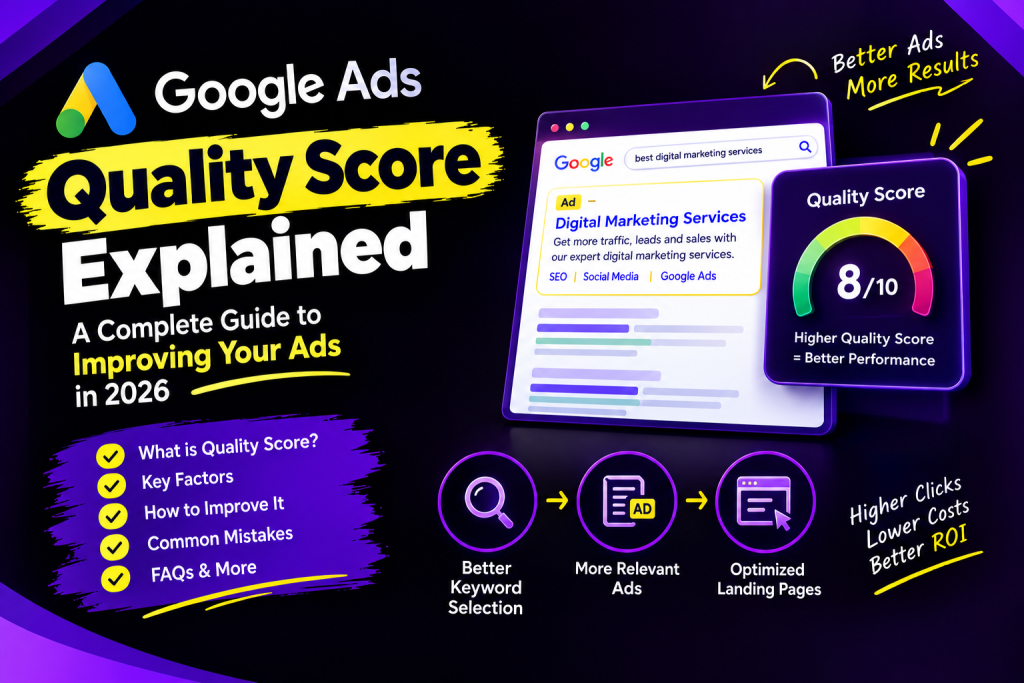
Google Ads Quality Score Explained: A Complete Guide to Improving Your Ads in 2026
Google Ads Quality Score Explained Google Ads is one of the most popular online advertising platforms that allow organizations to bid on search terms and place their ad copy in front of the target audience. Yet, bidding on keywords and designing catchy headlines and text isn’t enough. One should take into account that the created advertisement should be relevant and match the landing page that appears after clicking on the ad. The main key performance indicator (KPI) that shows how successful the Google advertising campaign is by comparing it to the average Quality Score of similar ads in the auction is Google Ads Quality Score. Essentially, this metric evaluates the relevance of advertisements, keywords, and landing page. Understanding the scoring system and learning how to improve it is essential in getting the best possible score. This guide will discuss what Google Quality Score is, how it works, factors that influence it, and the best practices to boost it. What Is Google Ads Quality Score? Google Ads Quality Score is a diagnostic metric that rates the quality of your keywords and related advertising experience on a scale of 1 to 10. Google calculates this keyword-level score using three main components: Expected click-through rate (CTR) Ad relevance Landing page experience Each element may be graded as Below average, Average, or Above average. Quality Score assists the advertisers in the comparison of their ads on the basis of the same search terms with others’ advertisements. It should be remembered that Google considers this score as a diagnostic instrument and not as an input for the auction process directly. For instance, if your keyword’s score is 4 out of 10, you should take a close look at the expectation of CTR, ad relevance, and landing page. It is not essential to aim for the highest score, but it is critical to make your advertisement relevant and beneficial for the customers. Why Is Google Ads Quality Score Important? Quality score helps in understanding how well the keywords, ads, and landing pages rank together to meet the expectations of users. H3: 1. Helps Recognize Issues With Advertising A low score may indicate that the advertisement lacks strong relevance to the search term or that the landing page is unsatisfactory. By analyzing all three factors, one can easily detect which element requires optimization. Otherwise, if the quality score is high, this means that no changes are necessary. H3: 2. Enables More Relevant Advertising High relevance is one of the most significant advantages provided by quality scores. In case of proper organization, the advertisement will have a better chance of appearing when users search online using specific keywords. Moreover, the ad will address their queries more specifically, which means that the customers will find exactly what they are looking for. H3: 3. Enhances Landing Page Experience A high-quality landing page enables the user to receive the information that they need quickly and easily. First of all, it should be visually appealing so that the customer would not leave it immediately after opening. Secondly, it should contain valuable content and be easy to navigate. It goes without saying that the faster the page opens and the more useful information it provides, the more satisfied the user will be. H3: 4. Allows Optimizing the Campaign As has been mentioned above, quality score serves as a basis for optimizing the keywords, ads, and landing pages. However, even though it may boost the campaign’s performance, it does not guarantee any specific results such as reduced cost per click or increased conversion rate. What Are the Three Main Factors of Google Ads Quality Score? Expected CTR estimates how probable it is that your ad will get a click for the specific keyword. It is based on data about how Google’s algorithm is likely to react to the queried term independently on its position and other factors. An appealing ad with a good match to the search term can entice users to click on it. How to improve expected CTR: Write clear and engaging headlines. Match your ad message to the keyword. Explain the main benefit of your product or service. Use relevant calls to action. Add suitable assets, such as sitelinks, when helpful. Avoid misleading promises or unrelated messages. Example: If someone searches for “SEO services for small businesses,” an advertisement that clearly offers SEO services for small businesses is more relevant than a generic advertisement about digital marketing. Ad Relevance Ad relevance measures how closely your advertisement matches the intent behind a user’s search. If your keywords, headlines, descriptions, and offer are connected, your advertisement can provide a more useful experience. How to improve ad relevance: Organize keywords into closely related ad groups. Write ad copy that matches the keywords in each group. Include relevant terms naturally in headlines and descriptions. Make the advertised offer clear. Avoid placing unrelated services in the same ad group. Ensure the ad accurately describes the landing page. Example: Suppose you run a campaign for website development services. An ad group targeting “WordPress website development” should contain ads focused on WordPress development rather than unrelated services such as email marketing. This makes the relationship between the keyword and advertisement clearer. H3: 3. Landing Page Experience Landing page experience evaluates how useful and relevant your landing page is for people who click your ad. Even a well-written advertisement may perform poorly if the destination page is confusing, slow, difficult to use, or unrelated to the search. How to improve landing page experience: Make sure the page matches the advertisement. Provide the information promised in the ad. Improve page loading speed. Make the page mobile-friendly. Use clear headings and readable content. Make contact forms and buttons easy to find. Avoid intrusive pop-ups. Keep important information accurate and easy to access. Example: If your advertisement promotes Google Ads management, the landing page should explain your Google Ads service, its benefits, your process, and how customers can contact you. Sending visitors to an unrelated homepage may create a less helpful