
What Is AI Content Creation?
Definition of AI content creation
How generative AI works at a fundamental level
What content can be created with AI
Examples of AI-generated content
How businesses and marketers can use AI
H3: What Can AI Help You Create?
Give examples including but not limited to:
Blog ideas
Blog drafts
Social media posts
Emails
Product descriptions
Ad copy
Video scripts
Content outlines
Headlines
SEO content ideas
Content repurposing
H2: Benefits of AI Content Creation
Clearly explain the key benefits
Use subheadings for the most important benefits
H3: Saves Time
Explain how AI can help with researching, brainstorming, organizing, outlining, writing, and editing
H3: Helps Generate Content Ideas
Explain how AI can help overcome writer’s block challenges
H3: Helps Ensure Content Consistency
Explain how businesses can leverage content generation tools to maintain a consistent publishing schedule
H3: Helps Personalize Content
Explain how businesses can create multiple variations of the same article to personalize for different audiences
H3: Assists With SEO and Content Strategy
Explain how businesses can use AI content generation tools for keyword suggestions, article structures, search intent, topic clusters, and other SEO and content strategy considerations while emphasizing the need for human review
H3: Helps Small Business
Explain how small businesses with limited time and resources can use AI content generation to support their content marketing needs
7. CHALLENGES SECTION
H2: Challenges of AI Content Creation
Explain that while AI content creation presents many benefits, there are also potential drawbacks
H3: Lack of Original Human Perspective
Explain how content created with AI lacks the benefit of human insights, including a human perspective, unique viewpoints, and even creativity
H3: Accuracy and Inaccuracy
Explain how AI content generation tools can produce both accurate and inaccurate information, including out-of-date information, and encourage users to seek additional information to confirm accuracy
H3: Generic or Repeating Content
Explain how content created with AI can lack uniqueness, brand voice, and personality, especially if the user simply copies content generated by AI without making modifications
H3: Brand Voice Concerns
Explain that businesses and brands must review content created with AI to ensure that it reflects the desired brand voice, audience, and personality
H3: SEO and Quality Concerns
Explain that simply generating large volumes of content with AI does not guarantee SEO value or quality content, and emphasize the importance of relevance, originality, accuracy, search intent, and audience appeal
8. BEST PRACTICES
H2: Best Practices for AI Content Creation
Give clear, actionable business writing advice, such as:
Use H3 headings for each best practice
H3: Define Your Content Objectives
Explain the importance of defining what you want to accomplish with each written piece
H3: Provide Clear Instructions to AI
Explain how being specific and clear with instructions helps the AI respond more accurately
H3: Leverage Human Expertise
Explain how writers and other professionals can add value to AI-generated content by providing their own expertise, examples, experiences, and insights
H3: Double-Check Stats, Facts, Figures, Quotations, and Dates
Explain the importance of fact-checking and verifying information, especially statistics, facts, figures, dates, specific quotations, and product or industry information
H3: Edit for Brand Voice
Explain how businesses can edit AI-generated content to reflect the appropriate tone and brand voice
H3: Keep the Reader in Mind
Explain the importance of creating content that serves the reader and provides value to the reader rather than focusing on keywords or other search engine optimization concepts
H3: Use AI as an Assistant, Not a Crutch
Emphasize the importance of ensuring that humans are involved in the content creation process
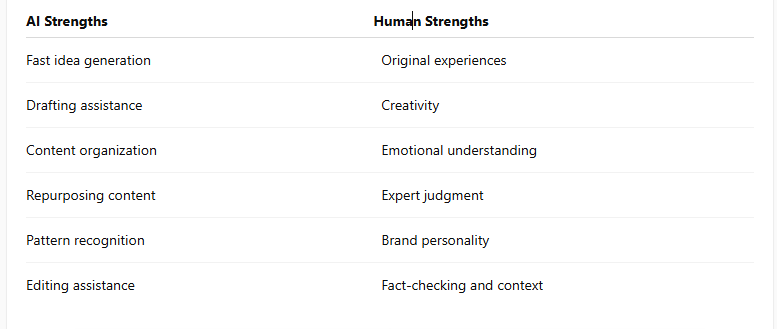
AI + HUMAN COLLABORATION
AI vs. Human Content Creation: Why Both Matter
AI Strengths
human Strenth
AI CONTENT CREATION WORKFLOW
A Simple AI Content Creation Process
Explain a process or task in a simple way. You need to create a step by step guide on how I would approach writing a blog post.
H3: Step 1 – Defining your audience
H3: Step 2 – Pick a content goal
H3: Step 3 – Do keyword research on your topic
H3: Step 4 – Write a prompt for an AI content writer
H3: Step 5 – Get an initial draft from the AI tool
H3: Step 6 – Apply expert knowledge and human skill
H3: Step 7 – Fact checking and editing
H3: Step 8 – SEO optimization
H3: Step 9 – Publishing the blog post and measuring results
COMMON MISTAKES
Common AI Content Creation Mistakes to Avoid Essay
Explain mistakes such as:
Publishing unedited AI content
Using wrong information
Keyword stuffing
Generic content creation
Lack of focus on the target audience
Plagiarism
Overreliance on AI
Lack of brand voice
Creating content for search engines
Failure to evaluate content’s success
FUTURE OF AI CONTENT CREATION
The Future of AI Content Creation
Address the ways in which AI may continue to influence:
Content personalization
Marketing automation
Multichannel content
Video and visual content
Content repurposing
Data-driven content strategies
Customer experiences
CONCLUSION
AI can make content creation faster, more efficient
AI has many benefits but also limitations
human creativity and expertise is still important
Fact-checking and editing is always crucial
Businesses need to strategically use AI instead of mindlessly
The best content creation uses a mixture of AI and human skills.
Frequently Asked Questions(FAQ)
1. What is AI content creation?
AI content creation is the use of artificial intelligence tools to support the writing process, develop blog and social media posts, construct emails, compose product descriptions, write scripts, and produce other marketing content.
2. What are the main benefits of using AI content creation?
The benefits of using artificial intelligence to create content include time-saving, generating ideas, planning content, being more productive, and creating different types of content.
3. Can AI-written content be used for SEO?
Artificial intelligence can be used to create SEO content, including coming up with topics, developing an outline, doing keyword research, and writing the draft. It is to be noted that the produced content should be informative and accurate, have proper keywords, and be checked by a human before publication.
4. Can AI replace copywriters?
AI can support copywriters in many tasks, ranging from ideation to proofreading. At the same time, copywriting requires professional expertise, knowledge, and skills that only people can demonstrate. Therefore, AI cannot replace copywriters.
5. What are the common problems with AI content creation?
The most common problems with the content created by AI are the provision of incorrect information, having the same content, being repetitive, boring, and having uninteresting content.
6. How can businesses leverage AI to support content marketing?
Companies can use AI to brainstorm, plan content strategies, create outlines for blog posts, develop social media content, write emails, and repurpose content. However, all these tasks require human input and should be supported by human writing.
7. How can one make AI-generated content sound more human?
To sound more human, AI-generated content should include personal opinions, experiences, and examples, as well as brand details and be free of AI writing patterns. In addition, the generated content should be edited and proofread.
8. What are the best practices for effective AI content creation?
The best practices for AI content creation are to have a clear purpose, give detailed instructions, use quality data, add the writer’s expertise, double-check the facts, be consistent with the brand, and edit the content.
9. Can AI content be trusted?
AI content cannot be fully trusted because it can provide wrong information and data. Therefore, vital statistics, figures, and facts should be verified using other resources before publishing the article or information generated by AI.
10. Can small businesses use AI to create content?
Small businesses can benefit from using AI to create content as it can help them save time and do the necessary tasks, ranging from planning to proofreading. As such, small businesses can leverage AI while incorporating human input to create better content.