
AI Marketing Automation: How to Grow Your Business Smarter in 2026
Marketing is transforming as more companies are using Artificial Intelligence (AI) to better understand their customers, create content, run campaigns and improve performance. Many time-consuming tasks can be supported by automation tools and AI.
AI marketing automation is a strategy which uses artificial intelligence and automation to help businesses better communicate with their customers.
This can include automatically sending welcome emails to new subscribers, suggesting products based on a customer’s interests or using AI tools to see which campaigns are working well.
Not only does it save businesses time, but it can help them provide customers with more accurate communications, meet their needs and make data-driven decisions.
In this guide, we’ll cover what AI marketing automation is, how it works, the benefits of using it, common tools and practical strategies to help your business grow in 2026.
What Is AI Marketing Automation?
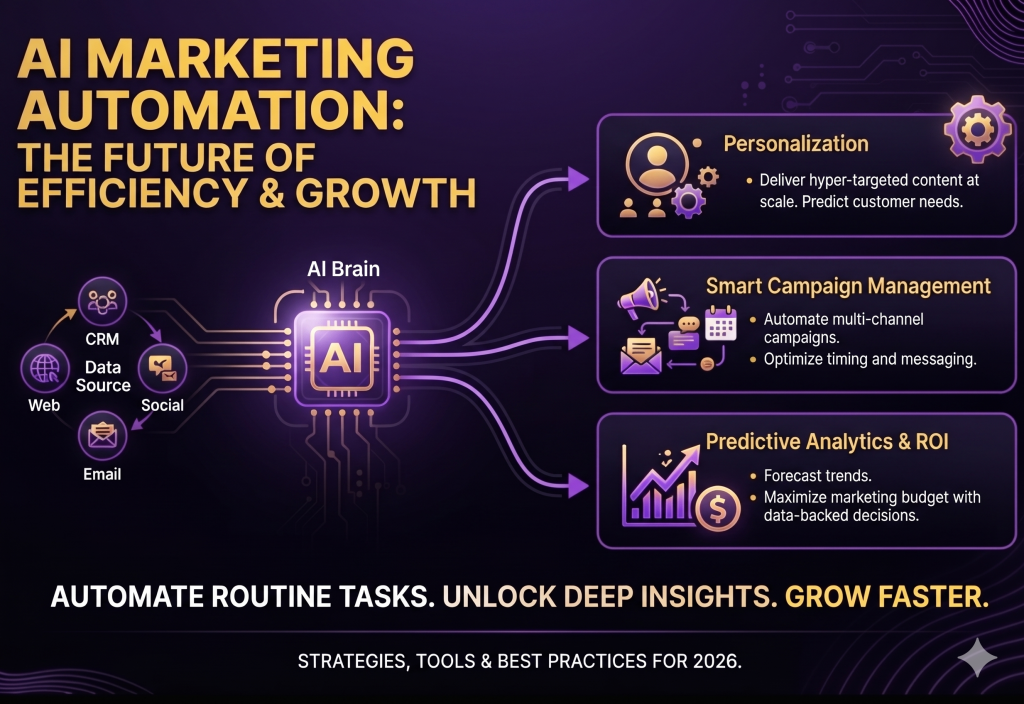
AI marketing automation uses artificial intelligence and automation tools to plan, organise, personalise and improve your marketing efforts.
Traditional marketing automation will use set rules. For example, when a new subscriber signs up to your newsletter, they’ll automatically receive a welcome email.
AI marketing automation can take this a step further by using the data available to identify patterns and predict what topics your customers are likely to be interested in, making it easier for you to personalise your communication with them.
These can be used for email marketing, social media management, generating leads, segmenting customers, optimising advertising and providing customer support.
For example, if you run an online clothing store, when customers visit your website and look at a specific category you may want to use your marketing system to suggest related items or send them relevant messages (assuming they’ve given their permission).
This means you can provide more relevant communication.
How Does AI Marketing Automation Work?
AI Marketing Automation uses customer data, automation and AI to aid marketing.
H3: 1. Customer Data
Marketing can gather data from web visits, emails, purchases and customer forms (and other linked data) depending on privacy regulations.
This gives insight into customer behaviour and interests.
H3: 2. Customer Behaviour Analysis
Using AI tools you can analyse the data you have to look for trends. This will help to segment customers with similar interests. It can also help predict what products or messages might be relevant to your audience.
This isn’t always 100% accurate so it is a good idea to keep an eye on results and not assume anything about individual customers.
H3: 3. Automation Workflows
You can create workflows to complete certain tasks.
For example, sending a welcome email once someone has subscribed or notifying sales when a qualified lead completes an enquiry form.
H3: 4. Targeted Marketing
AI can help personalise your subject line of emails, recommend products, suggest content and advertise. This should be helpful to your customers and should be respectful.
H3: 5. Reviewing Performance
Marketing platforms can help you review how well your campaigns are doing. This can give insight into how many clicks, conversions, engagement and revenue you’re getting.
From this information marketers can improve their workflows, try out new messages and make better decisions.
Benefits of AI Marketing Automation
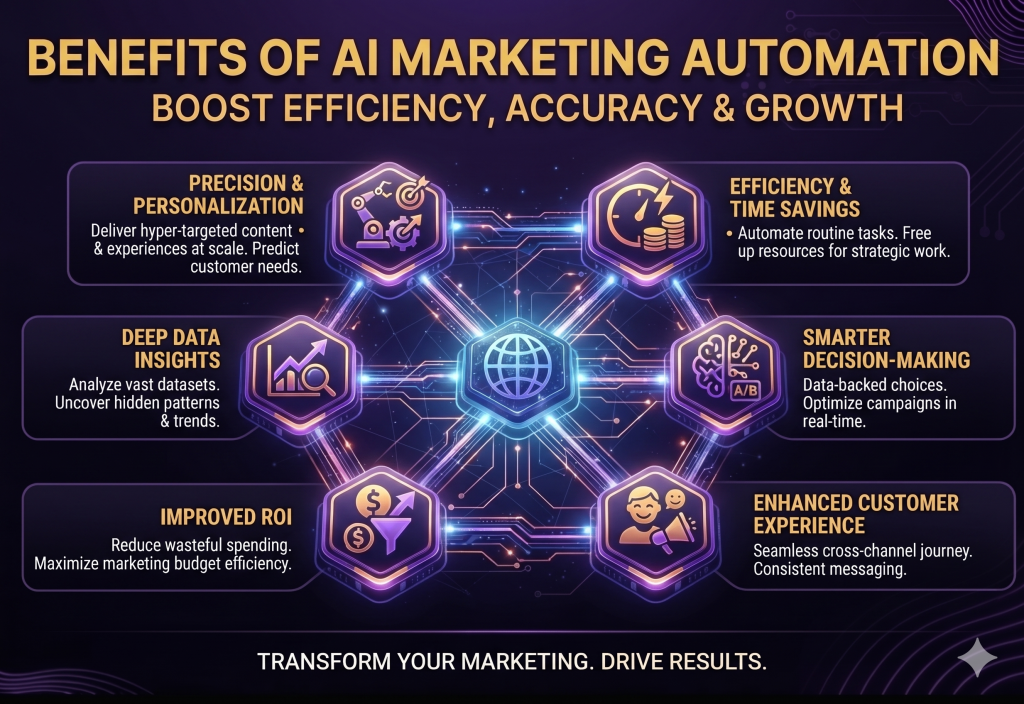
There are many benefits of using AI marketing automation.
H3: Saves Time
Marketing teams can often waste a lot of their valuable time by doing manual processes like setting up email campaigns, lead management, reports and other repetitive tasks.
With automation many of these can be done for you. Employees will have more time for strategic thinking, creativity and focusing on the customer experience.
For example a business can set up an automated email drip campaign.
H3: Better Personalisation
Customers will engage with your messages more if they feel it is relevant to them.
With AI you can personalise recommendations for your customers based on what you know about them. This can create a much more useful communication.
H3: Lead Generation and Nurturing
An AI system can help you identify high quality leads, organise customer data and know who to prioritise for follow up.
For example, a digital marketing agency can capture new enquires automatically, allocate to a sales rep and send relevant information to potential customers.
Care should be taken to ensure you are not overlooking useful leads due to lead scoring.
H3: Better Decision Making
Using AI tools will help you analyse the data from your campaigns and identify patterns.
This will help you understand which channels, messages and audiences to focus on for further experimentation.
However, you should always ensure that the recommendations from the AI are not taken at face value and are instead analysed against the business outcomes.
Enables More Consistent Customer Communication
Automated workflows can allow you to send messages at the right time in the customer journey.
This could be an email welcoming them to your business, reminder emails for appointments, abandoned cart messages and post purchase follow-ups.
By keeping communication consistent it can create a better customer experience.
H3: 6. Helps businesses scale their marketing
As a business grows you will have more customers and more campaigns to manage.
AI marketing automation can help you manage increased volumes of communication without having to increase every part of your marketing manually. However workflows will still need to be monitored and maintained.
Types of AI Marketing Automation
Email Marketing Automation
Email marketing automation sends messages based on customer actions, preferences, or predefined schedules. AI can assist with audience segmentation, subject-line suggestions, and campaign analysis.
Examples:
Welcome emails
Product recommendations
Follow-up emails
Customer re-engagement campaigns
Post-purchase messages
Social Media Marketing Automation
Social media can be used to help plan out your social media posts, and track engagement, comments and insights.
AI can help you generate ideas, write captions and analyse what’s trending. Your posts will still need to be checked by a human to make sure they are in line with your brand style and the information is correct.
H3: 3. Advertising
Using AI within your advertising platforms can help to automate your bidding, optimise how your ads are served and identify what audience or ad combination could work best.
You’ll still want to check your budget, conversions, targeting and quality of your advertising campaigns.
H3: 4. Content Marketing
AI tools such as content writers and researchers can help you with coming up with ideas, planning out content, summarising information and reusing content.
We’d recommend checking the content produced by AI to make sure it is accurate, unique, useful and in line with your brand.
H3: 5. Chatbots
Chatbots powered by AI can help you answer common questions, direct people to the right page, gather information on the enquiry and pass complicated requests to a human.
Make sure your customers can easily get in contact with someone if the automated system doesn’t help them.
H3: 6. Lead Management
Lead management systems can help you capture lead information, assign leads to members of your team, schedule follow ups and track the progression of your leads through the sales pipeline.
AI might help you prioritise your leads based on the information available. Important decisions should still be checked by your sales team, and customer information should be kept accurate.
Popular AI Marketing Automation Tools
| Tool | Common Uses |
|---|---|
| HubSpot | CRM, lead management, email campaigns, and marketing workflows |
| Mailchimp | Email campaigns, audience segmentation, and automated customer journeys |
| ActiveCampaign | Email automation, customer journeys, and CRM workflows |
| Zapier | Connecting applications and automating repetitive tasks |
| Salesforce | CRM, customer data, and AI-supported marketing workflows |
| Google Ads | Automated bidding and campaign optimization features |
| ChatGPT | Marketing ideas, content drafts, research assistance, and workflow planning |
Features, integrations, pricing, and AI capabilities vary by plan and may change over time. Before choosing a tool, check whether it supports your required workflows and connects with your existing systems.
How to Implement AI Marketing Automation in Your Business
Start by setting a clear goal that you want to achieve.
H3: 1. What do You Want to Achieve
What are you looking to improve? More leads, less repetition, better engagement with your emails or increased sales online?
Define clear goals to ensure your choosing the right tools and will know how to measure your success.
H3: 2. Know Your Audience
Who are you targeting? What do they need? What questions do they often ask? How do they like to be contacted?
Ensure you are using accurate customer information and only collecting any information needed.
H3: 3. Choose the Right Tools
Ensure the tools you choose are suitable for your business, and budget. Check if they can integrate and give you control around data privacy. Ensure they are user friendly and provide you with reports.
H3: 4. Start Small
Choose an activity to automate that is repetitive e.g. sending a welcome email, allocating new web leads to a team member.
Carefully test this process.
H3: 5. Stay Personal
Use personal information that is relevant to your customers. Ensure they have opted in, and can easily opt out. Don’t flood them with too many communications, or be too invasive.
H3:6. Measure and Improve
Ensure you are measuring the right key performance indicators (KPIs) to track your success. Using a KPI that will help towards your goal. E.g. conversion rate, quality leads, email engagement, cost per acquisition and revenue.
Compare your results over time, and use the accurate information to improve.
Common AI Marketing Automation Mistakes to Avoid
Although automation can be useful, poor implementation can create problems.
Automating everything at once: Begin with manageable workflows and expand after testing.
Ignoring human review: Check AI-generated content, recommendations, and important customer messages.
Using poor-quality data: Inaccurate information can lead to irrelevant targeting and unreliable insights.
Sending too many messages: Excessive communication can annoy customers and increase unsubscribes.
Ignoring privacy: Follow applicable data protection requirements and respect customer consent.
Focusing on tools instead of goals: Choose technology that solves a real marketing problem.
Failing to measure results: Review performance regularly to determine whether automation is delivering value.
The best approach combines AI efficiency with human judgment, creativity, and accountability.
What Is the Future of AI Marketing Automation?
AI marketing automation is likely to become an increasingly important part of marketing. Businesses may use AI to help them with planning campaigns, creating customer segments, generating content, analysing performance and providing a personalised experience.
However, a successful marketing strategy will still depend on trust, useful data, creativity and understanding your customers.
If you use automation in combination with quality content, ethical data use and some human oversight then you will be better set up to change as marketing technologies evolve.
Focus on tools that will help support your customers and provide real value for your business.
.
Frequently Asked Questions (FAQs)
1. What is AI marketing automation?
AI marketing automation uses artificial intelligence and automated workflows to support marketing activities such as email campaigns, lead management, personalization, advertising, and performance analysis.
H3: 2. How does AI marketing automation help small businesses?
It can reduce repetitive work, organize leads, personalize customer communication, and help small teams manage marketing activities more efficiently. The best starting point is usually one simple workflow tied to a clear business goal.
H3: 3. Is AI marketing automation expensive?
Costs vary by tool, plan, contact volume, integrations, and business needs. Some platforms offer free or entry-level plans, while advanced features may require paid subscriptions. Businesses should compare the cost with the time saved and results achieved.
H3: 4. Can AI marketing automation replace marketers?
AI can assist with repetitive tasks and data analysis, but it does not replace the need for human strategy, creativity, judgment, relationship-building, and accountability. Human oversight remains essential.
H3: 5. Which AI marketing automation tools are best?
HubSpot, Mailchimp, ActiveCampaign, Zapier, Salesforce, and Google Ads offer different automation capabilities. The best choice depends on your goals, budget, existing software, and required integrations.
H3: 6. How can I measure AI marketing automation success?
Measure results using relevant metrics such as conversion rate, qualified leads, email engagement, customer acquisition cost, revenue, and time saved. Compare results against your goals and review performance regularly.
Conclusion
AI marketing automation helps to simplify marketing processes, understand how customers behave, and ultimately create more relevant experiences. Email automation, social media posting, lead management and advertising can all be improved through using this technology.
However, businesses should know they have clear objectives, accurate data, valuable content, responsible customer communications and regular reviews.
Begin by focussing on one process, pick the right tool and track the results. Using the combination of AI with your employees’ creativity and strategy will help your business create an effective digital marketing strategy.
Ready to Grow Your Business With Smarter Marketing?

At DiginovaHub, we help businesses strengthen their online presence through SEO, Google Ads, social media marketing, content marketing, and website development.
Whether you want to generate more leads, improve your marketing campaigns, or build a stronger digital strategy, our team can help you explore solutions that match your business goals.
Connect. Engage. Convert. Grow. — DiginovaHub