
What Is the Digital Marketing Journey?
Define it as the process a person goes through from identifying with a brand to engaging with it, considering its products or services, buying them, and, possibly, becoming a brand loyalist.
Explain that each customer’s journey is unique
Elaborate on such factors as customer needs,
industry,
product price,
brand trust,
competition,
customer experience
marketing channels
The Main Stages of the Digital Marketing Journey
Discuss Channels such as:
Google Search
Social media
Google Ads
Online videos
Blog content
Recommendations
Display advertising
Explain the role to SEO and content marketing.
Example: A person searching Google for “best digital marketing services for small businesses” finds a company’s website.
H3: 2. Interest — Capturing Attention
Explain the interest stage (after discovery). Businesses should provide value and encourage the visitor to stay on the website and learn more.
Discuss:
Helpful blog posts
Social media
Videos
Infographics
Educational content
Website pages
Explain how valuable content encourages the visitor to spend more time learning about your brand.
H3: 3. Consideration — Building Trust
Explain that potential customers will typically compare several businesses (in their consideration set) before purchasing.
Discuss how a business can gain trust with customers by including:
Customer reviews
Testimonials
Case studies
Helpful content
Service information
FAQs
Professional website design
Social proof
Explain why credibility matters at this stage.
H3: 4. Conversion — Turning Visitors Into Customers
Explain what a conversion is. Examples of conversions include:
Making a purchase
Completing a form
Booking a consultation
Calling a business
Signing up for a service
Requesting a quote
Explain how a business can improve conversions using:
Clear CTAs
Simple forms
Strong landing pages
Navigation
Relevant offers
Trust signals
Mobile-friendly design
Explain that not every click will result in a customer.
H3: 5. Retention — Turning Customers Into Repeat Customers
Explain that digital marketing does not end with a sale. Discuss how a business can continue to engage with a customer and turn them into a repeat buyer. Possible examples:
Email marketing
Personalized communication
Loyalty programs
Helpful content
Follow-up messages
Product recommendations
Customer support
Explain why it is an important component of the marketing strategy.
H3: 6. Advocacy — Turning Customers Into Brand Supporters
Explain what customer advocacy is. Discuss examples of how customers can advocate for your brand, such as:
Reviews
Referrals
Social media mentions
Testimonials
User-generated content
Word-of-mouth recommendations
Explain how you can encourage customers to advocate for your business voluntarily. Do NOT claim that all of your satisfied customers will become brand advocates.
How Digital Marketing Channels Work Together
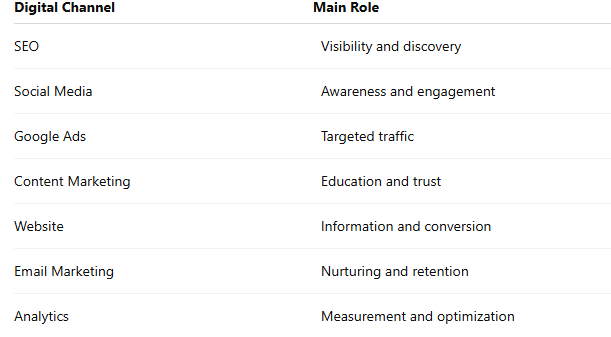
Explain that companies should not necessarily think of SEO, social, ads, content, and email marketing as separate activities.
Explain how different activities could support different phases.
Create a simple table:
From Clicks to Customers: Why Traffic Alone Isn't Enough
Traffic
Discuss why businesses should look beyond:
- Clicks
- Impressions
- Followers
- Views
Business results
and also consider:
- Leads
- Conversion rate
- Customer acquisition
- Sales
- Repeat purchases
- Customer lifetime value
How to Improve the Digital Marketing Journey
Provide practical strategies.
H3: Know your audience
Explain the value of understanding customers including their needs, questions, concerns, and preferences
H3: Create useful content
Explain the value of educational and relevant content to guide customers through the buyer’s journey.
H3: Optimize the website
Discuss:
Responsiveness on mobile devices
Speed of website
Navigation ease
Effective Calls to Action
Clear information about the service or product
H3: Build trust
Include:
Reviews
Testimonials
Case studies
Providing information and building professional brand imagery for the business
H3: Use data
Explain how the use of data can help businesses learn where their customers are leaving the customer journey or where they need help.
Common Digital Marketing Mistakes Businesses Should Avoid
Describe the common mistakes like:
H3: The Focus on Quantity
explain why the increase in traffic without the right visitors or poor conversion rate will not bring the desired results
H3: Poor Website Experience
explain why the complicated website structure and the poor user experience kill any marketing efforts
H3: Trying to Use Any Marketing Channel
explain why the company should not use every channel available but instead chose the most suitable ones according to their needs
H3: Lack of Follow Up
explain why the lead nurturing campaigns via email marketing or other channels are essential
H3: Lack of Focus on Current Customers
explain why the current customers should be engaged in the marketing campaigns too
How to Build a Simple Digital Marketing Funnel
Give one example of a practical business application of this information.
Use this structure:
Awareness
SEO + Social media + Google Ads
↓
Interest
Blogs + Videos + Educational Content
↓
Consideration
Services + Reviews + Testimonials + Case studies
↓
Conversion
Landing page + CTA + Contact form
↓
Retention
Email marketing + Customer Support + Valuable Content
↓
Advocacy
Reviews + Referrals + UGC
Explain each step briefly.
Frequently Asked Question (FAQ) About the Digital Marketing Journey
1. What is the digital marketing journey?
Digital marketing journey encompasses the entire process of getting a customer from being aware of a brand to ultimately purchasing and even advocating for the business.
2. How do clicks turn into customers?
Clicks can be turned into customers when businesses have the right content, build trust, offer a good experience on their website and include CTAS.
3. What are the main stages in the digital marketing journey?
The main stages in the digital marketing journey are awareness, interest, consideration, conversion, retention, and advocacy. All these stages are crucial for the customer journey.
4. Why is SEO important in the customer journey?
SEO allows the company to appear in front of searching customers and generate traffic to the business, resulting in the conversion.
5. How does social media help to attract customers?
Social media helps attract customers by building brand awareness, providing informative content about the business, connecting with potential customers, and displaying the products and services.
6. How does content marketing help to convert visitors?
Content marketing assists with educating customers, building trust, and establishing credibility to get more customers to convert.
7. What is the difference between a click and a conversion?
A click is registered when a person clicks on a link while a conversion happens when a person takes the desired action such as making a purchase.
8. Why is a good website so important to turn visitors into customers?
A good website converts visitors into customers because it meets their expectations, is easy to navigate, and has a strong CTA. Besides that, the website should also have relevant and informative content.
9. How can email marketing help the customer journey?
Email marketing can help the customer journey by assisting in engaging, building trust and relationships with the audience. It also helps deliver relevant and personalized content to the target customers.
10. How can businesses improve their digital marketing journey?
The business can improve their digital marketing journey by targeting the right audience and developing relevant content. Moreover, the business should build trust with customers, optimize their site, enable effective CTAS and analyze the marketing efforts.