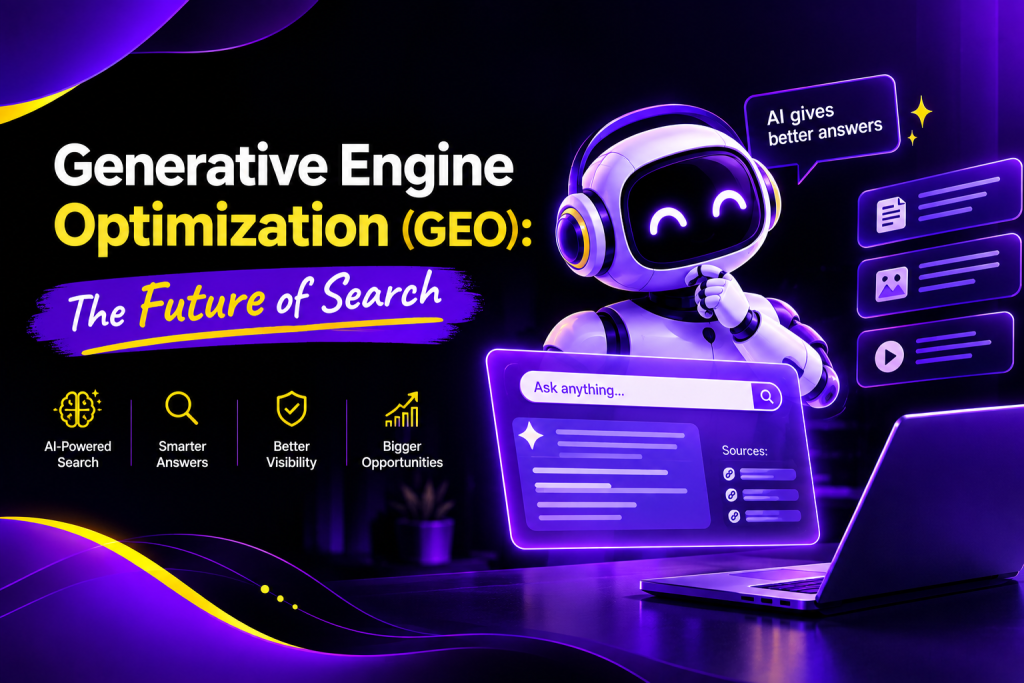
“Generative Engine Optimization (GEO): The Future of Search”
The article should be suitable for a professional digital marketing agency website and easy enough for beginners, small business owners, marketers, startups, entrepreneurs, bloggers, and business professionals to understand.Explain Generative Engine Optimization (GEO) in simple language and help readers understand how search is changing with AI-powered search engines and answer engines. Generative Engine Optimization (GEO): The Future of Search Explain how people are relying more and more on AI-augmented search experiences to find information, compare and contrast, summarize, and get straight answers to questions. Introduce GEO as an approach that focuses on raising the probability that relevant website information is gleaned, surfaced or cited by AI-generated responses What Is Generative Engine Optimization (GEO)? Definition of Generative Engine OptimizationWhy the term GEO is being usedHow GEO fits in with traditional SEOThe goal of being informative and helpful to searchers, building trustworthy content that’s easily discovered and understood by AI-driven search Explain that GEO is a fledgling field and certain practices and terminology are still changing How Does GEO Work? Understand a user’s question Interpret context and intent Retrieve or use information Compare information from different sources Generate a natural-language response Potentially provide links or citations to sources Avoid pretending to know the proprietary ranking or retrieval systems of specific AI platform Why Is Generative Engine Optimization Important? Explain why marketers are getting so interested in GEOs Discuss the changes in the way people search for informationthe rise of AI-driven searchthe importance of visibility in the right placesand the value of providing information that people actually need.Also, explain why companies need to change their content strategies Make sure to keep your claims objective and avoid suggesting that traditional search engines are becoming irrelevant. GEO vs SEO: What’s the Difference? Key GEO Strategies for Better AI Search Visibility Key GEO Strategies for Improving Search Visibility The process of generative engine optimization aims to improve the visibility of material in the search results of AI-driven discovery systems. However, contrary to popular belief, it is not focused on keywords. Rather, it emphasizes clarity, quality, and reliability of information. 1. Write informative and original content Produce informative and original content to improve the visibility of your material. Focus on addressing specific questions and offering relevant information. Remember to supplement your arguments with additional data, examples, and personal or professional insights. 2. Answer questions directly and clearly Address the questions you receive in your field directly and clearly. Structure your material in a way that makes the most sense and is easiest to follow. Use subheadings, brief paragraphs, lists, FAQs, and Q&As to make the most important information easy to spot. 3. Provide examples and expert insights Make sure to include examples and expert insights when appropriate. Doing so might help you demonstrate the value of your content. Moreover, it can facilitate the creation of better-quality material. 4. Establish topical authority Build topical authority by developing a comprehensive piece of content about a particular topic. Create supplementary material regarding the same subject and link to it to build an internal network of resources. 5. Provide clear definitions and explanations Explain all the necessary definitions and terms clearly and concisely. Support all the claims you make with reliable and credible evidence. Moreover, remember to omit any unsupported information. 6. Update content when necessary Update old content if new data, statistics, links, examples, or recommendations become available. It will benefit both the readers and search engines. On the one hand, you would be able to provide more relevant information. On the other hand, you would improve the search engine optimization of the material. 7. Use descriptive subheadings and supplementary elements Use descriptive subheadings and supplementary elements, such as lists, tables, and FAQs. The presence of these elements, along with relevant internal links, will make your material easier to process for both humans and machines. Overall, GEO is not about optimizing for artificial intelligence. Rather, it is about providing high-quality information in an accessible manner. In doing so, you would both satisfy and educate your audience. Moreover, you would improve the overall search visibility of your material. How to Optimize Existing Content for GEO The optimization of the existing content for GEO is the process of editing and enhancing the performance of the current pages in order to make the information on them more accessible and better perceived by the readers and algorithms. In addition, the optimization of the existing content may be a great option to improve the quality of content and increase the efficiency of the content strategy. 1# Understand Search Intent To optimize the existing content for search engines, first, you need to research the search intent of the keyword you are going to optimize. The content has to fully respond to the request and answer the questions and/or solve the problems of the readers. 2# Know the Most Asked Questions Make a list of the most common questions related to your optimized topic. Then, incorporate them into your text and try to answer them fully and in detail. 3# Optimize the Structure of Your Text Highlight the most important parts of your text with subheadings (H2 and H3), bullet points, and numbered lists. Additionally, you can also use tables to make the information on the page more accessible and easy-to-read. 4# Provide Direct Answers When optimizing text for search engines, make sure to answer the most common questions upfront and give additional information after that. 5# Additional Information, Sources, Examples, and Expertise Add more information, statistics, and data to your optimized text. Cite the sources you used for research, provide examples and cases, and increase the quality of content by adding your expertise and knowledge. 6# Update the Information on the Page When optimizing your old content, remember to update the information on the page if necessary. Check the facts, numbers, links, sources, examples, screenshots, and other elements. 7# Interlinked Content Interlink the related pieces of content using the appropriate anchor text. GEO Best Practices for Businesses Write for people firstUnderstand search intentProvide answears to