
Google AI Mode & What It Means for Your SEO in 2026
Search is evolving. Users are no longer interested in simply plugging a few words into Google and clicking on the first link that appears. They are searching for more in-depth answers to their specific questions.
In addition to the usual Google search, a significant trend is Google AI mode.
Google AI mode is an innovative AI-powered Search experience that is designed to help users find more comprehensive answers to their queries. It is intended for complex questions, follow-up exchanges, and deeper exploration of the world’s information. As of 2026, Google has enhanced its capabilities to continue its improvements in AI-powered Search and to further enrich the discovery of websites and content on the web.
What does this evolution of search mean for SEO? Does SEO suddenly become irrelevant? The answer is no.
However, SEO tactics must now shift to emphasize the importance of content that is not only SEO optimized but also informative and well-structured.
What Is Google AI Mode?
Google AI Mode is an AI-powered Search experience that lets users ask more complex and conversational questions.
Instead of searching for a few stand-alone keywords, users can ask one detailed question and then follow-up with additional questions to continue the conversation.
For example, rather than searching:
“best digital marketing strategy”
a user could ask:
“What digital marketing strategy should a small business use if they have a limited budget and want to generate leads online?”
Google’s AI can decompose complex questions into related subtopics, and perform a search across multiple areas to create a more expansive view of the topic. Google refers to this as query fan-out.
AI Mode can also work with different forms of input, including text, voice, and images.
Google launched AI Mode in India in 2025, letting users ask questions, explore topics with follow-ups, and get links to relevant web content.
Google AI Mode vs. Traditional Google Search
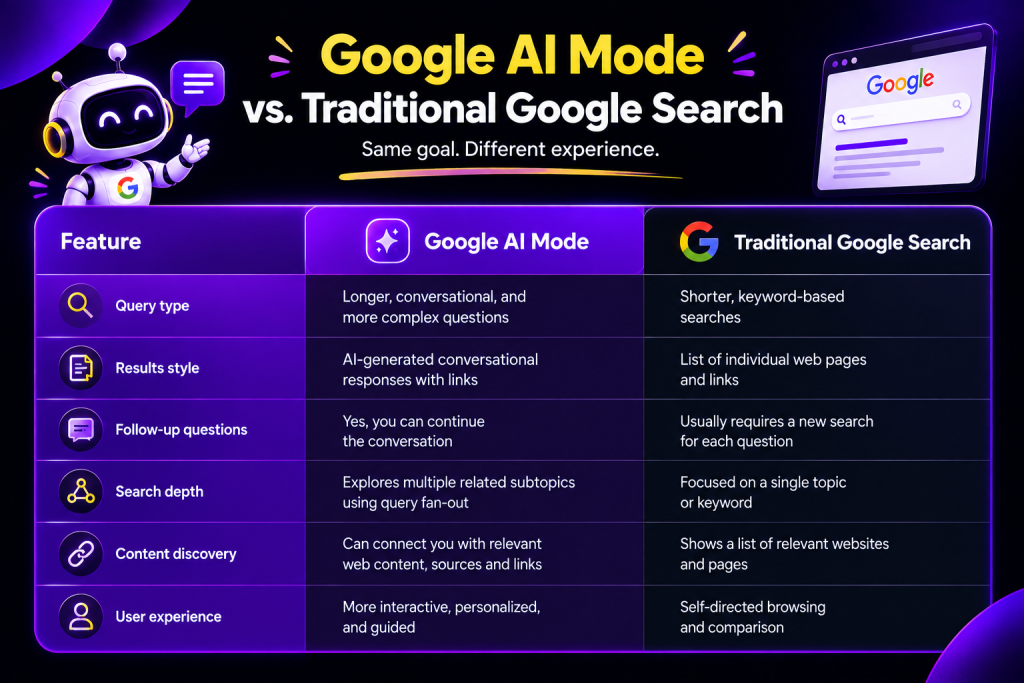
Google AI Mode vs. AI Overviews
What Are AI Overviews?
AI Overviews can give you an AI-powered summary within Google Search for certain queries. They can help introduce a topic quickly, and will include links for further reading.
What is AI Mode?
AI Mode lets you go deeper into a more conversational search, and follow up on related queries.
You may remember Google began testing different AI-powered search experiences, and recently began testing the ability to transition between them. In 2026, Google introduced a unified vision for an AI-powered Search experience, where users can move from an AI Overview into AI Mode, and follow links to related topics.
Why Does This Matter for SEO?
It implies that businesses need to think beyond targeting one keyword.
Your content should be informative enough to answer questions and address related questions that your target audience will have.
What Does Google AI Mode Mean for SEO in 2026?
The growth of AI-powered Search does not spell doom for SEOs.
Rather, it is a transition away from a narrow focus on content quality and relevance to a more holistic consideration of contextual appropriateness, search intent, website accessibility, and end-user requirements.
Some trends that businesses should be aware of are as follows:
Search Queries Are Becoming More Conversational
It is now possible to ask Google more nuanced questions in a more natural language.
Google announced in 2026 that, on average, an AI Mode query in the United States was three times longer than a regular Search query.
As such, businesses should take advantage of this shift and focus on creating content around questions, rather than simply keywords.
For instance, instead of just focusing on the keyword ‘SEO services’, a company could also create articles or web pages answering the question ‘how can SEO services aid a small business in gaining more website visitors?’
Long-Tail Keywords Are Becoming More Useful
Examples may include:
questions about improving your local SEO as a small business,
the benefits of SEO for an e-commerce site,
the best content marketing practices for a start-up,
or ways to boost your website’s organic traffic.
Your customers’ search queries will often tell you exactly what they are looking for.
Therefore, it is vital to answer them truthfully and thoroughly to provide the best possible solution.
Content Must Answer Real Questions
One of the most common mistakes companies make is creating content for the sake of keywords.
Ask yourself,
Does this article actually help the reader?
A good article should have explanations, examples, information, and answers to related questions.
Google has also begun prioritizing connecting users with useful websites, original content, and first-hand experience in their AI Search features.
How to Optimize Your Website for AI Search
There is no secret sauce that can ensure that one’s website appears in AI-generated Search results.
However, businesses can take a number of steps in order to improve their presence.
Following the best SEO and content creation practices can improve the likelihood of getting discovered.
Make the Articles Useful and Differentiating
It is important to note that one should not write generic articles that do not offer any additional value.
One’s articles should rather include
one’s own advice,
examples,
research, case studies,
experiences, expert opinions, and unique perspectives
The more useful the article is for the reader, the more valuable it is.
Understand Search Intent
Before creating an article, learn to understand the query.
A person searching for
“what is SEO”
would probably want a definition
Someone searching for
“SEO agency near me”
is likely to click on the first result
But a person searching for
“SEO pricing for small businesses”
might want a price comparison
Understanding the intent behind a search can help us create articles that answer questions and solve problems.
Use Conversational Keywords Naturally
You don’t need to write awkward sentences in an attempt to include keywords.
Instead, you can ask questions throughout your content.
For example:
H2: How Can Small Businesses Improve SEO?
And then answer the question below it.
That way, it’s much easier to both read and understand your content for people and search engines.
Keep Your Technical SEO Strong
The use of AI-driven Search does not imply that technical SEO is no longer important.
Focus on:
Crawlability
Indexability
Mobile usability
Website structure
Page speed
Descriptive URLs
Headings
Internal linking
Accessible content
to help your content be found and understood by search engines.
Why Traditional SEO Still Matters
With all the hype about AI Search, it’s easy to think that companies need to rethink their SEO strategy.
They shouldn’t.
Core aspects of SEO still matter.
Your website should still have:
Valuable content
Proper keywords
Strong search intent
Effective website structure
Internal linking
Technical SEO
Mobile-friendliness
User-friendly design
Accurate information
Google has revealed that AI Search features are based on its established quality and ranking systems.
How to Measure SEO Performance in the AI Search Era
The success of SEO is never only about the number one spot.
The companies should also look at how their website is performing and whether it is delivering value and results.
There are several key metrics that need to be followed, including:
Organic traffic
Impressions
Click-through rate
Leads
Conversions
Engagement
% of returning visitors
Branded searches
Performance in Search Console
Moreover, Google is now going to provide more and more reports and insights for website owners as Search is becoming more and more AI-powered. For example, in September 2026, Google launched a feature in Search Console that is providing reports about multimodal web searches, including Lens, uploading images, and other visual Search interactions.
Common SEO Mistakes to Avoid in 2026
Writing Only for Keywords
While keywords are important, an article should not be written as if it’s for a search engine and not humans.
Publishing Generic AI Generated Content
AI can be useful, but just creating generic articles with it and publishing them is not a good idea.
Not Addressing Search Intent
Even if you have the most well-optimized page, if it doesn’t answer peoples questions, it will not be successful.
Not Generating Original Content
Do not just scrape what other sites are saying and put it on your own. Create articles that have their own examples and experience, or at least information that isn’t just regurgitated from another page.
Neglecting Technical SEO
Writing quality content is important, but hosting it on a site that is difficult to navigate and index is not effective.
Not Updating Old Content
While creating new content is important, neglecting your old content is a big mistake. Make sure that all your content is up-to-date, especially if any time-sensitive information is present.
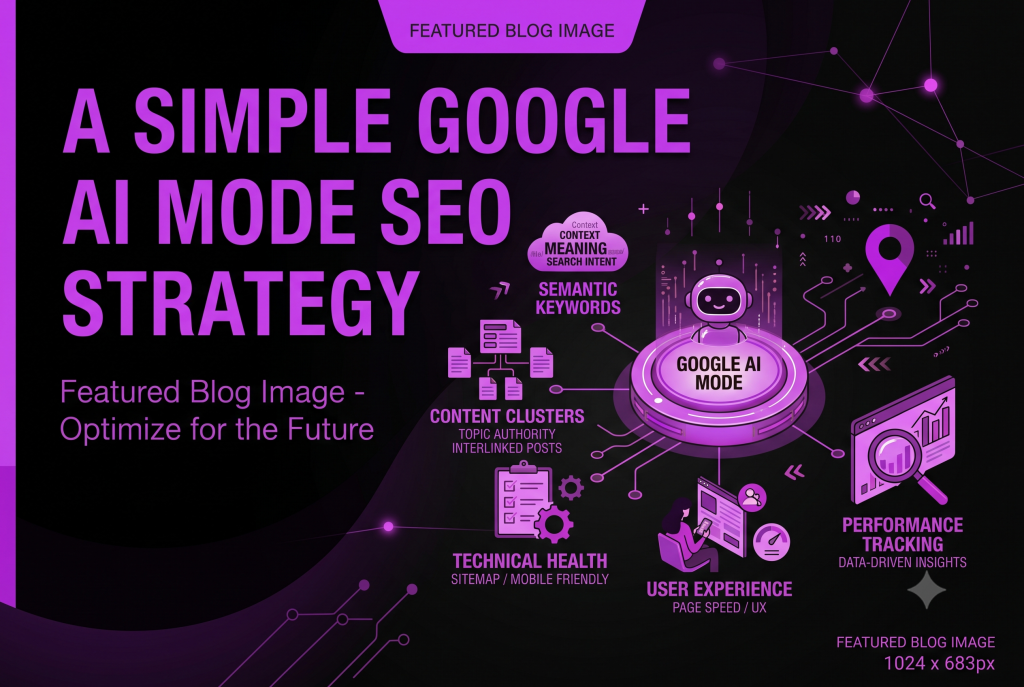
A Simple Google AI Mode SEO Strategy
Step 1: Know Your Customers
Figure out what you customers are looking to learn and discover
Step 2: Research your Niche
Use customer feedback, keyword research, Q&A forums, sales and marketing questions and topics on industry newsletters to discover relevant questions and subjects for your content.
Step 3: Understand Searcher Intent
Differentiate between informational searches and transactions. Understand what a person looking for your services or products is searching for.
Step 4: Create Value
Write helpful informative and comprehensive articles and web content dedicated to addressing and answering the questions on your topic niche.
Step 5: Add Your Expertise
Add value with related material such as examples or anecdotes, insights, research or expert opinions.
Step 6: Information Architecture
Optimize website organization and navigation. Create good URLs, informative headings and support internal linking.
Step 7: Technical SEO
Ensure your technical housekeeping is in order; crawlability, indexing, mobile-friendliness and overall presence on the page.
Step 8: Content Maintenance
Update cornerstone content offerings on an ongoing basis and ensure that information provided is accurate and up-to-date.
Step 9: Analytics and Actions
Use tools like Google Search Console and Web Analytics reports to evaluate findings and draw conclusions.
Step 10: Stay Informed
The way Google search works is constantly changing. As such businesses must stay up-to-date with trusted sources of information on Google Search trends.