
Top Digital Marketing Trends for 2026: Strategies Every Business Should Follow
Digital marketing trends in 2026 are evolving at an unprecedented rate as new technologies and consumer behaviors continue shaping the digital landscape. Organizations are now harnessing artificial intelligence and other emerging technologies to automate and personalize marketing activities. Moreover, modern customers are embracing multiple avenues to discover new products and services, including social media, video content, artificial intelligence, and interactive platforms. These developments are creating new opportunities that digital marketers can use to transform their strategies, engage customers, boost sales, and achieve other marketing objectives. Therefore, all business owners, including small-scale entrepreneurs, start-ups, and big corporations, need to identify and understand modern digital marketing trends.
This blog contains vital information on the best digital marketing trends in 2026. The article highlights key issues and provides relevant background information on the topic. Moreover, the authors also give practical recommendations on how different businesses can use the trends to transform their marketing campaigns.
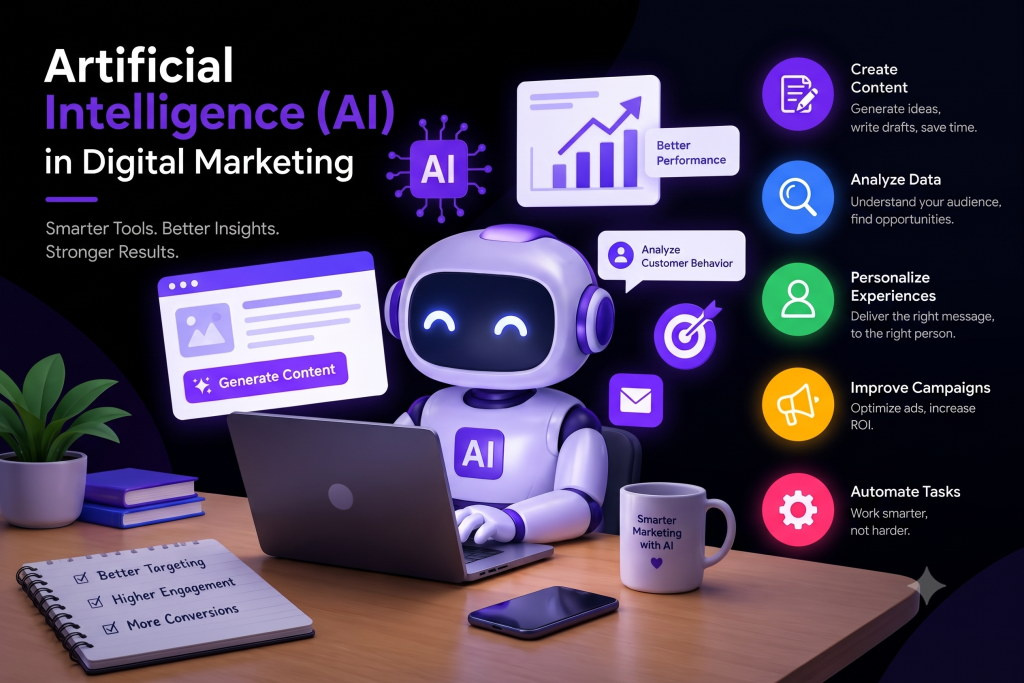
Artificial Intelligence (AI) in Digital Marketing
Artificial Intelligence has become a significant trend in modern digital marketing. Today, companies use AI to create content and analyze and track customer behavior. In particular, AI helps to optimize marketing performance, automate repetitive tasks, and obtain specific marketing insights that would take much longer to acquire without artificial intelligence.
There are several ways to apply AI in digital marketing:
Come up with ideas for blogs,
analyze customer behavior,
produce marketing reports,
optimize advertising,
automate repetitive tasks
However, it is essential to note that AI-generated texts should be controlled by humans to ensure that they are accurate, error-free, and properly formatted.
H2 2: AI-Powered Personalization
Customers want relevant information and offers. AI-powered personalization allows you to give customers exactly what they want. For instance, if customers browse specific product categories on your website, you can suggest similar items or remind them of products that may be of interest to them. The same applies to email marketing, where you can send subscribers special offers based on their interests. AI-powered personalization helps to build relationships with customers and encourages them to return to your business.
Thus, the advantages of using AI for personalization include:
Relevancy,
Higher customer engagement,
Audience insights,
Better marketing campaign performance.
However, to achieve personalization, a company must have access to information about customers’ preferences and behavior. Therefore, it is critical to collect and use this data carefully to ensure security and privacy.
H2 3: Search Everywhere Optimization
Modern consumers use various channels to research and buy products and services. Therefore, it has become critical to optimize the presence in all platforms, not just Google. Optimization everywhere means that a company appears in the search results whenever a customer searches for a product or service on Google, YouTube, Instagram, marketplaces, and other platforms. In other words, an optimized website and social media accounts allow a customer to find a company at any stage of the purchasing process. For example, a customer may see an ad on Instagram, watch a YouTube review, and buy a product based on the information found on the company’s website.
It is essential to implement the following optimization tips:
Use keywords,
optimize social media accounts,
optimize YouTube,
publish informative blog posts,
ensure consistency of information,
Therefore, Search Everywhere optimization is critical to attracting customers at different stages of the purchasing process.
H2 4: Short-Form Video Marketing
Short-form videos are a significant trend in social media in 2026. Thus, companies should use the popularity of Instagram Reels and YouTube Shorts to promote their goods and services. For example, businesses can post short videos to demonstrate how to use their products, provide useful tips, answer customers’ questions, show behind-the-scenes content, and much more. A clothing retailer can post styling videos, while a digital marketing agency can give marketing tips.
Some ideas for short-form video marketing include:
Educational content,
Product reviews,
Behind-the-scenes content,
Answering customers’ questions.
Therefore, when using short-form videos for marketing purposes, it is essential to focus on creating value for customers rather than increasing views.
Voice Search and Conversational SEO
Voice search is a new way for people to find information by talking instead of typing. Users are communicating with their phones, smart devices, and virtual assistants. Therefore, companies must optimize their content for voice search.
For instance, instead of searching for “best digital marketing agency,” a buyer may ask for which digital marketing agency helps small businesses grow.
How to optimize the content for conversational search:
Make sure the frequently asked questions (FAQ) are well-organized.
Use common language and answer the questions fully.
Implement long-tail keywords.
Remove barriers for mobile users.
Moreover, the content that answers specific questions will perform better in the SERP (search engine results page) for traditional and conversational search.
H2: 6. Marketing Automation
Marketing automation is a technology that facilitates the marketer’s repetitive tasks. Simultaneously, it minimizes human errors. Instead of doing everything manually, professionals use programs that design, execute, and control marketing activities.
Some samples of marketing automation are distributing newsletters, following up with customers, reminding buyers about abandoned purchases, and sending out marketing emails. For example, once a person subscribes to a blog, a marketer gets notified so that he can send a welcome email right away. It could include information about the company’s products and services.
The benefits of marketing automation are as follows:
Time and effort-saving.
Helping establish effective communication with clients.
Keeping track of leads.
Managing and analyzing successful campaigns.
Moreover, automating marketing tasks makes it easier for companies to engage with their customers without doing any time-consuming activities manually. However, it is essential that the marketers review the emails or messages periodically to make sure that everything is smooth, relevant, and personalized.
Influencer and Creator Marketing
Influencer and creator marketing can help companies to design effective promotional strategies. In 2026, businesses are looking to partner with creators who appeal to a certain type of customer and therefore serve as a useful channel for targeting specific audiences. For instance, a company selling cosmetics can benefit greatly from collaborating with a beauty vlogger who shares useful content about skincare and often reviews various products.
Tips for using creator marketing:
Work with creators whose audiences match the desired customer base;
Produce valuable content;
Define clear goals for the collaboration;
Measure engagement and conversion rates;
Clearly state that the creator is promoting the brand in exchange for compensation.
Therefore, it is vital to focus on the relevance of a creator’s content rather than the size of their following.
Data-Driven Marketing and Customer Privacy
Data-driven marketing refers to using information and analytics to understand consumer behavior and optimize business based on marketing activities.
Using website analytics, feedback collection, email, and campaign reports, businesses can track desirable and undesirable outcomes and improve performance.
At the same time, customers are increasingly concerned about how their data is collected, used, and shared. As such, privacy is a critical consideration in customer-centric marketing.
Key data-driven marketing considerations include:
Tracking key marketing performance indicators
Collecting relevant information while respecting consumer privacy
Using the information responsibly and ethically
Regularly reviewing performance and optimizing
Ensuring the security of customer data
The combination of analytical information and privacy protection is critical for effective, ethical marketing.
Social Commerce and Shoppable Content
Social commerce refers to the combination of social media discovery and online shopping. In other words, it is a process where customers can search for products on social media and, if the platform provides the option, purchase them directly.
Product demo, video content, reviews, and product-related social media posts can be leveraged to persuade customers to make purchases.
Social commerce tactics include the following:
Showcasing product demo content.
Making engaging shopping-related videos.
Using product tags, when possible.
Answering questions in comments and messages.
Providing information about your products.
As such, social commerce can facilitate the decision-making process of customers who are considering buying your products.
Content Marketing with Human Creativity
Content marketing is an indispensable tool in customer acquisition and education. The company can attract clients and provide them with useful information by publishing blogs, articles, videos, infographics, and social media content.
However, even though AI can support and improve research and editing processes, human ingenuity and expertise are undoubtedly valuable and irreplaceable.
The following content marketing ideas may be relevant and beneficial for the company in 2026:
1. Publish informative blog posts.
2. Write original case studies.
3. Share practical industry-related advices.
4. Transform existing blogs into videos and infographics.
5. Update the content of previous years with the most recent data.
Overall, implementing the content marketing strategy is crucial for any company that wants to retain consistency and foster lasting relationships with customers.
How to Prepare Your Business for Digital Marketing Trends in 2026
Following every trend is not necessary for every company. It is essential to analyze what your audience likes, what your objectives and budget are, and what tools the company can use.
The five most common steps to take when starting a new business include the following:
Identify the audience
determine which trends to follow;
create engaging content;
apply the most relevant tools;
and collect analytics.
First, it is essential to identify the audience and clarify what they want and need.
Second, determine which trends to follow based on the company’s objectives and budget.
In addition, creating engaging content is crucial to ensure that companies address the customers’ most pressing concerns. Moreover, the company must find the most relevant tools, including AI, to make the process easier. Finally, analyzing the collected data and measuring the link between web traffic and sales will determine what works and what does not.
Frequently Asked Questions (FAQs)
H3: 1. What are the top digital marketing trends are for 2026?
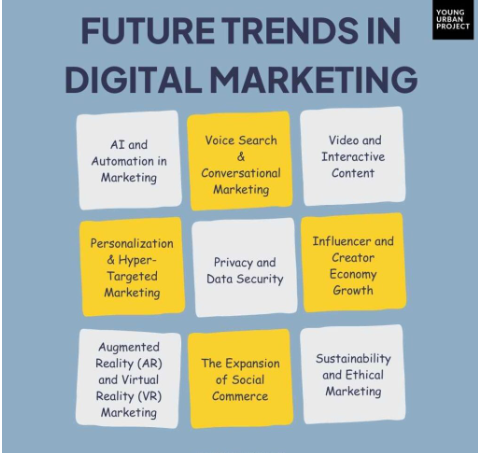
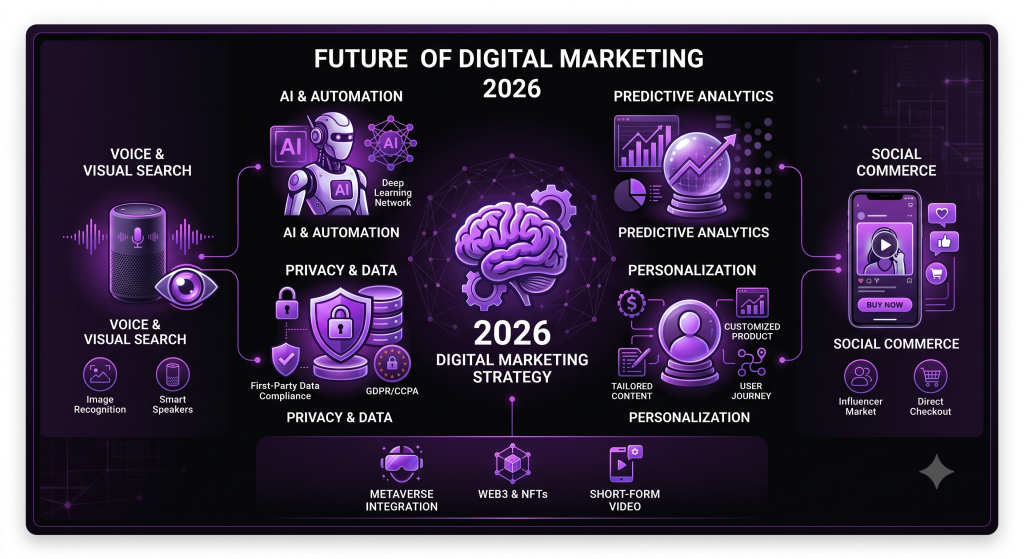
Top digital marketing trends for 2026 consist of AI-powered marketing, customer experience personalization, Search Everywhere Optimization, short-form video consumption, conversational SEO, marketing automation, and creator marketing.
H3: 2. How is AI disrupting digital marketing in 2026?
AI in digital marketing allows companies to create content, study customers’ behavior, personalize marketing, automate repetitive tasks, and optimize campaigns with the profound examination of data; however, human oversight is required.
H3: 3. Does SEO still matter in 2026?
Yes, SEO does still matter because it facilitates users’ access to the necessary information via search engines, and businesses are adjusting to the changes in search and discovery.
H3: 4. What is the best digital marketing trend for small businesses?
Everything depends on a company, its objectives, and customers; thus, the best digital marketing trend for small business is to invest in content marketing, local SEO, short-form videos, and utilizing certain artificial intelligence.
H3: 5. How to keep up with digital marketing trends?
To keep up with digital marketing trends, it is critical to follow the leading business and marketing sources, examine the changes within the platforms, invest in education, analyze statistics, and test trends at scale.
Conclusion
Digital marketing in 2026 will be dominated by sophisticated technology, customer-centric approaches, and improved means of engaging with consumers in virtual environments. The main trends include artificial intelligence (AI), personalization, Search Everywhere Optimization, short-form videos, automation, and content marketing.
Nevertheless, not all digital marketing trends should be adopted by organizations. Firms must identify their target audience and choose the most appropriate trends and neglect the others. By combining contemporary technology and human expertise, businesses engage in effective digital marketing and prepare for the future of marketing.