
Keyword Research Using AI: A Complete Guide to Smarter SEO in 2026
Introduction
Keyword research is one of the most essential aspects of Search Engine Optimization (SEO). It lets businesses see what individuals are looking for on the web and the subjects they need to cover in their site material to attract traffic. The process, however, can be quite time-consuming, especially if sifting through search terms, competition, and intent.
Lucky for us, search engine optimization keyword research is one of the areas where artificial intelligence (AI) can make our jobs much easier. AI-driven tools are transforming how marketers find keywords, examine trends, and create SEO-friendly content. The technologies could recommend related search terms, address keyword gaps, and collect and organize reams of information much faster.
For bloggers, digital marketers, business owners, and SEO newbies, learning about keyword research and utilizing AI is a great way to start building an excellent SEO strategy.
In this blog, we will discuss everything about using AI for keyword research, including the benefits, tools, and methods.
What Is Keyword Research Using AI?
Keyword research using AI refers to utilizing artificial intelligence technologies to identify, analyze, and collect search terms.
While researching keywords, you typically look for search volume and difficulty. Using AI can make keyword research much easier since it can help come up with variations of a keyword and identify related topics. Let’s say you have a digital marketing blog and decide to target the keyword “SEO tips.” An AI tool can recommend related keywords and topics, such as:
SEO tips for beginners
How to improve website rankings
On-page SEO checklist
Technical SEO best practices
AI tools for SEO
These suggestions can help you discover new blog ideas and understand what your audience may be looking for.
However, AI-generated suggestions are not automatically verified keyword data. You should use dedicated SEO tools to check search volume, competition, and relevance.

Why Is AI Important for Keyword Research?
AI is revolutionizing keyword research with its ability to free marketers to get the work done.
H3: 1. Save Time and Effort
With the help of artificial intelligence, one can easily come up with a list of ideas and relevant keywords in seconds. Instead of brainstorming and coming up with keyword suggestions, artificial intelligence can help come up with possible keywords and group them according to topics.
H3: 2. Target Long-Tail Keywords
Long-tail keywords are search phrases that are usually long and highly specific.
Targeting long tail keywords is easier with the help of artificial intelligence. For instance, in addition to targeting “digital marketing,” one can dig deeper and come up with relevant searches, such as “digital marketing strategies for small businesses.” This way, one can come up with better keywords that target a niche audience.
H3: 3. Know Search Intent
In general, search intent refers to the reasons why people search online. For instance, one might want to find a specific website, compare products, conduct research, and so on. With the help of artificial intelligence, keywords can be separated into certain types of search intents to help one come up with relevant ideas.
H3: 4. Discover Content Opportunities
Artificial intelligence can help one identify content opportunities, such as related topics and questions. By discovering related topics and issues, businesses can develop new content and improve the ones they already have.
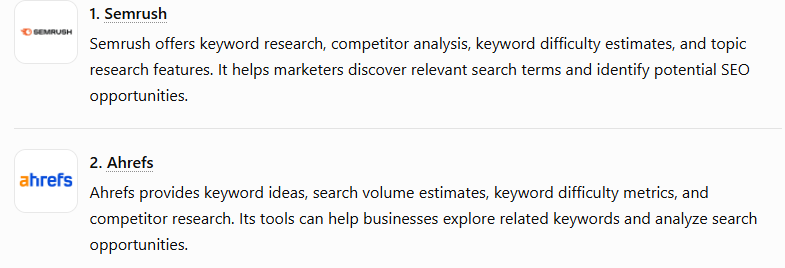
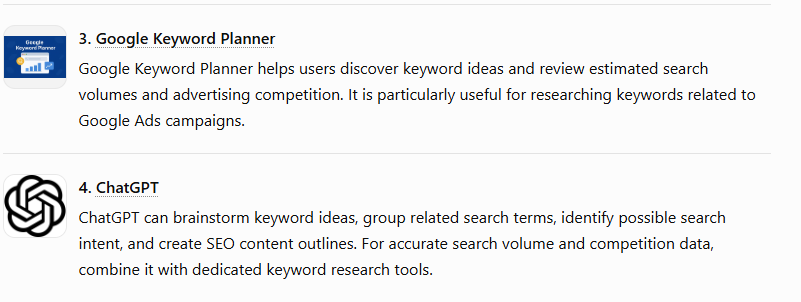
H2: Top 8 AI Tools For Keyword Research In 2026
There are several digital tools that one can use for keyword research. The following are the best AI tools for keyword research in 2026.
How to Do Keyword Research Using AI: Step-by-Step Guide
H3: Step 1: Choose Your Main Topic
The first thing to do is pick a topic that is relevant to your business, website, or target audience.
For instance, if you have a digital marketing blog, your main topic could be “social media marketing.” Put this phrase into an AI and ask it to come up with keyword ideas.
H3: Step 2: Ask an AI to Come up with Keyword Ideas
Ask an AI tool to come up with primary, secondary, tertiary keywords, and frequently asked questions (FAQs) about the topic. Here is what you can say:
Step 3: Analyze Search Volume and Keyword Difficulty
After completing the keyword list, it is possible to move on to the next step in SEO content creation. It includes performing keyword research with the help of SEO tools. One should look for keywords that are relevant and have a reasonable level of difficulty, considering the website’s possibilities.
It is essential to analyze the search volume and competition and identify which keywords will be the most beneficial for the website. At the same time, one should remember that high search volume does not always equal high traffic.
H3: Step 4: Understand Search Intent
It is also critical to understand the search intent behind keyword queries. In particular, it is necessary to distinguish between informational, navigational, commercial, and transactional searches. For example, a query about the definition of email marketing is clearly informational, while a request for the best email marketing software is commercial.
After identifying search intent, it is possible to choose the type of content and its format to answer the query.
H3: Step 5: Create an SEO Content Plan
The next step is to create a content plan based on keyword clusters. In particular, it is necessary to separate keywords for topics and determine the primary and additional keywords for each post. Then, using keyword research and the search intent behind it, it is possible to plan content, headlines, and frequently asked questions.

Traditional Keyword Research vs. AI Keyword Research
Comparison | Traditional Keyword Research | AI Keyword Research |
|---|---|---|
Process | Mostly manual research and analysis | AI-assisted research and analysis |
Speed | Can take more time | Generates keyword ideas quickly |
Keyword Ideas | Relies on SEO tools and manual brainstorming | Suggests related keywords and topics |
Search Intent | Requires manual analysis | Helps identify possible search intent |
Long-Tail Keywords | Found through keyword tools and research | Generates specific, question-based keyword ideas |
Data Analysis | Often requires manual comparison | Helps organize and interpret keyword data |
Content Planning | Manual topic selection and grouping | Helps create topic clusters and content plans |
Accuracy | Depends on data sources and researcher expertise | AI suggestions need verification with reliable SEO data |
Tools | Google Keyword Planner, Ahrefs, Semrush | ChatGPT, Semrush, Ahrefs, and AI-powered SEO tools |
Best For | Detailed manual analysis and verified keyword metrics | Faster brainstorming, keyword grouping, and content planning |
Common Mistakes to Avoid in AI Keyword Research
Although AI can simplify keyword research, using it without proper review can lead to poor SEO decisions.
Trusting every AI suggestion: Always verify keyword relevance and search data.
Ignoring search intent: A popular keyword is not useful if your content does not match what users want.
Targeting only high-volume keywords: Specific long-tail keywords may be more suitable for your website.
Keyword stuffing: Avoid repeating keywords unnaturally in your articles.
Ignoring your audience: Focus on real customer questions instead of generating keywords just to fill a content calendar.
A thoughtful combination of AI suggestions, reliable keyword data, and human judgment can help you avoid these mistakes.
Frequently Asked Questions (FAQs)
What is the meaning of AI keyword research?
How does AI keyword research help?
AI keyword research can be utilized to brainstorm, organize, discover search intent, and even determine possible content opportunities.
2. Which AI tool assists with keyword research?
While ChatGPT and other AI language models can help with ideation
tools like Semrush, Ahrefs, and Google’s Keyword Planner can be used for keyword research. 3. Can AI keyword research uncover long tail keywords?
Yes, AI can be utilized to brainstorm specific, question-type, and long tail keyword ideas. However, it is always a good idea to ensure the search volume and relevance of these ideas with keyword research tools.
4. Is AI keyword research free?
Depending on the tool, some AI keyword research and general keyword research tools offer a free plan. With that said, many do require a paid subscription for in-depth keyword metrics and research.
5. Does AI keyword research boost SEO?
Keyword research conducted with AI can certainly aid in the creation of content that targets specific keywords and ideally improves rankings. However, rankings are impacted by multiple factors besides keywords, including content quality, intent, technical SEO, competition, and much more.

Conclusion
Keyword research using artificial intelligence is transforming the way companies approach SEO strategies. From long-tail keyword research to search intent identification and content brainstorming, AI can change the keyword research process and help complete the tasks efficiently.
However, businesses need to remember that keyword research is not just about compiling a list of search terms. Moreover, companies must verify the research results and identify the target audience’s needs and interests to create relevant content.
By using AI technology appropriately, one can ensure an efficient keyword research process, find credible keywords, and address the customers’ questions, which will ultimately improve the website’s ranking.