Author name: sidra@

SEO, Uncategorized

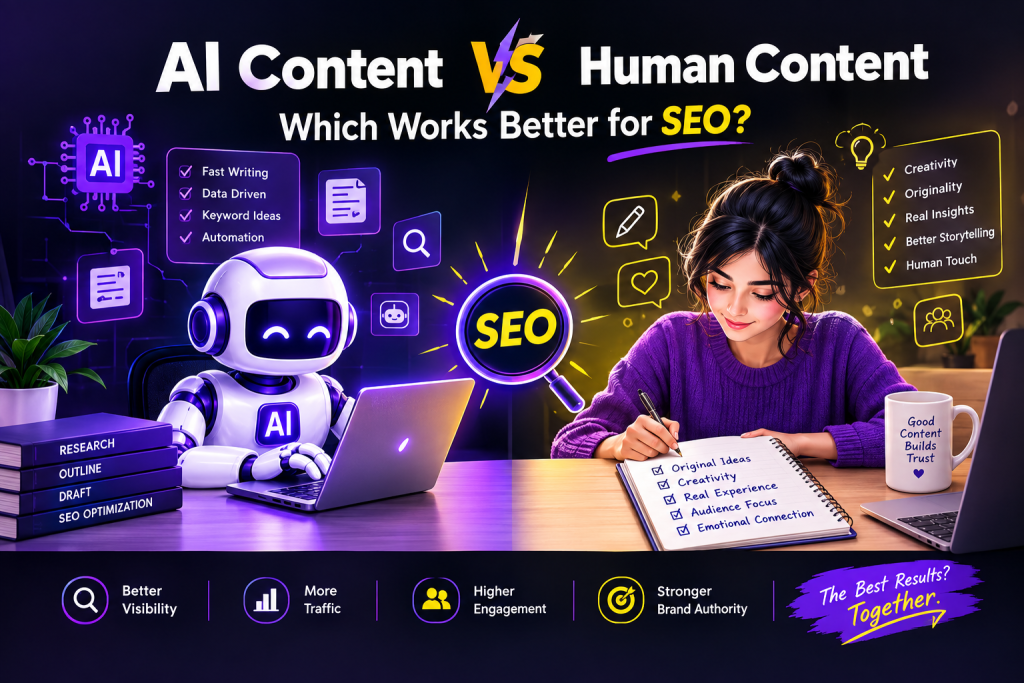
AI Content vs. Human Content: Which Works Better for SEO?

AI Content vs. Human Content: Which Works Better for SEO? As we know, artificial intelligence has been transforming the traditional approaches used in organizations. Now, in the modern business world, companies use artificial intelligence to create content for their online platforms. This technological advancement has significantly improved the strategies and structures of blog posts and descriptions of products and services. Moreover, businesses use AI to increase their search engine optimization (SEO) by coming up with the most appropriate keywords. However, human writers still play a crucial role in developing captivating content. With such an impressive innovation, many business owners and managers have often wondered which one is the best for SEO – AI content or human content? While AI can generate the content automatically, human writers have the ability to express their emotions, opinions, and thoughts in their writing. Thus, AI can help organizations to save time while generating content that can catch the reader’s attention. However, business owners should consider merging their strategies and use both AI and human writers to develop high-quality content that will satisfy their clients and customers. In this blog, we will discuss differences and advantages of AI content and human content and evaluate how these contents can be effectively used for SEO purposes and content marketing. What Is AI-Generated Content? AI generated content definition AI content refers to data created with artificial intelligence tools. It may take the form of text, images, or other types of information. The term generally refers to text generated with the help of language models, often using prompts provided by users. For instance, a digital marketer can use such tools to come up with blog post outlines, think of catchy titles, write product descriptions, or draft social media posts. Some common applications of AI writing tools include blogging, generating article ideas, searching for keyword suggestions, creating product descriptions, drafting email marketing content, or improving grammar and overall content quality. It can save time and effort when writing articles, but they still require human input and editing to ensure accuracy and contain all the necessary information that the target audience will find valuable. What Is Human-Written Content? Human-written content is created by people who use their expertise, information, and knowledge to create posts or articles. These people have an opportunity to understand the context of a certain topic and consider the audience’s emotions. For instance, if a digital marketing expert has to write an article about SEO, he/she will be able to introduce the key points of SEO, explain possible mistakes, and share personal skills or valuable experiences. The main advantages of human-written content include the author’s expertise originality, natural language and creativity, contextual understanding and judgment, and the ability to share personal experiences and examples. However, human-written content may also have such disadvantages as possible mistakes and/or repetition of the same words/phrases throughout the paper. It is also essential to edit and proofread human-written content since, similarly to AI-generated writing, it may need refinement to meet specific expectations or requirements. AI Content vs. Human Content: Key Differences AI and human writing have different strengths. Understanding these differences can help businesses choose the right content creation approach. Factors AI-Generated Content Human-Written Content Writing speed Produces drafts quickly Usually takes more time Creativity Generates ideas from learned patterns Brings original perspectives and creative judgment Personal experience Cannot independently provide real personal experiences Can share genuine experiences Accuracy May produce incorrect or outdated information Can research and verify information SEO optimization Helps with keywords and content structure Adds search intent and audience understanding Consistency Can follow a specified format Depends on the writer and editing process Cost Can reduce some content production costs May require more time and writing resources Editing Requires human review Also benefits from proofreading and editing Neither method automatically guarantees better SEO performance. Content quality, usefulness, accuracy, and originality are more important than the writing method alone. Benefits of AI Content for SEO AI writing tools can be used for SEO purposes by helping to optimize the content creation process. H3: 1. Accelerated Production AI tools can help to eliminate time-consuming monotonous tasks by generating article outlines, suggested introductions, headings, and even first drafts. H3: 2. Thematic and Structural Brainstorming AI-based writing tools can suggest blog post topics, associated keywords, and frequently asked questions. These can be helpful in developing a content strategy and calendar, as well as finding out what subjects to research further. H3: 3. Increased Productivity The ability to automatically edit, rewrite, summarize, and organize information means that writers and marketers can spend less time perfecting the superficial elements and focus more on conducting thorough research, fact-checking, and providing rich content. H3: 4. Content Optimization AI tools can also help to optimize the written content by suggesting what sub-topics to develop, what descriptive headings to use, and how to improve the piece’s fluency. This can be a great addition to one’s SEO strategy if used in combination with keyword research and analysis. H2: The Benefits of Human Content for SEO The benefits of human-generated articles are most apparent in one’s ability to conduct superior research, provide relevant and valuable information, and tailor the language and presentation to best suit the audience. H3: 1. Originality and Source Material A human writer can draw on their own experiences, provide case examples and studies, and highlight any lessons learned and nuances of their field. This can give the advantage of a personal touch that cannot be found in generic informational articles created by AI. H3: 2. Enhanced Empathy and Relevance Human empathy helps to provide the audience with what they want and need: information that is easy to digest and relevant to their industry. Human-generated articles can better address the audience’s real-life problems and situations. H3: 3. Engaging Language The natural use of engaging language, relatable examples, and creative storytelling can greatly impact the appeal and effectiveness of one’s content. Human creativity is particularly valuable in branded writing, promotional content, and creative pieces. H3: 4. Trust and
SEO, Uncategorized

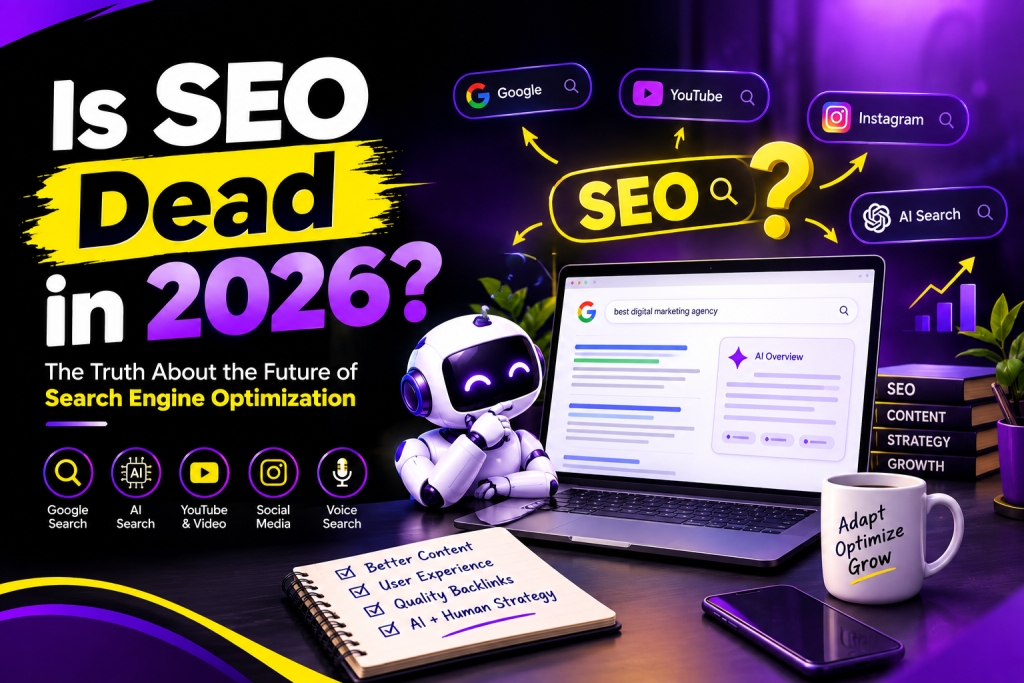
Is SEO Is Dead In 2026

Is SEO Dead in 2026? The Truth About the Future of Search Engine Optimization Introduction With the advancement in artificial intelligence, search engines, and online habits of customers, one pressing question has been circling the minds of marketers and website owners for quite some time now – is SEO dead in 2026? SEO is not dead, it has simply evolved beyond the traditional strategies that businesses were using on Google to rank #1. People are now searching for products and services through artificial intelligence, voice search, social media and more. As search engines become more intelligent, customers want quicker and more intuitive answers. Businesses and marketers must change their approach to SEO in order to stay relevant in the online sphere. In this blog, we will be discussing the reasons why people are asking “is SEO dead?” and what companies can begin doing now to improve their online presence and visibility in 2026. What Is SEO and Why Is It Important? Search Engine Optimization is a process that involves improving website content so that it appears more prominently in unpaid search results. SEO increases the ability of search engines to find your website or improves the relevance of information on the site. Search engines are capable of understanding the context and meaning of published content. Therefore, using “best digital marketing agency,” SEO will help ensure that the desired agency website appears among the search results when an exact query is made. The importance of SEO for businesses is demonstrated by increased online visibility, organic traffic, enhanced user experience, and brand building. In addition, SEO is a long-term investment that attracts constant traffic to the site. Therefore, SEO will remain an integral part of marketing due to the high traffic potential of search engines. : Why Do People Think SEO Is Dead in 2026? Several shifts in online search have confused about the future of SEO. H3: 1. The Rise of AI-Powered Search AI search tools are transforming research by providing features such as Google AI Overviews and AI Mode, which summarize information and offer links to relevant websites. Thus, users can obtain direct answers in the search page instead of going through many websites. Moreover, the AI search is still reliant on relevant web content for information, and Google says many tried-and-true SEO practices apply to its AI-powered search. CCNews +1 H3: 2. Changes in Organic Website Traffic Some sites are witnessing lower traffic even when they appear in the results due to the rise of AI search. Organic traffic refers to visitors who click through a link from a search engine to a website. As such, businesses should track various metrics instead of getting fixated on a page’s rank, and start focusing on more critical success factors like qualified visits, leads, engagement, and conversions. H3: 3. Increasing Online Competition More businesses are creating blogs, videos, and other online content than ever before. Thus, businesses must create informative and original content and offer a pleasant experience to increase their online presence and attract more visitors to their site. How Is AI Changing SEO in 2026? Artificial intelligence is changing everything in relation to search engines. It allows them to read beyond keywords and understand the context of queries and organize them accordingly. Let’s take a look at the main changes: H3:1. AI Overviews and AI Search AI Overviews summarize the results of specific searches and provide links to the necessary sites. At the same time, AI Search allows you to analyze the problem in greater detail since this technology can understand questions and perform searches based on them. Businesses need to create a quality asset that will provide visitors with precise answers. Google notes that all classic SEO rules remain relevant for AI search. , CCNews H3:2. Emphasis on Useful Content Search engines are designed to give people exactly what they need. Therefore, any content that only copies other resources without being useful in any way will simply not be found. Businesses need to focus on providing users with the most helpful information possible. It is advisable to include your own arguments, examples, and experience so that the site becomes a source of useful knowledge. H3:3. The Rise of Conversational Search People are now asking more questions than ever. However, they are trying to phrase them as fully as possible, not just typing a couple of words. An example of such a query might be a question about how to increase the traffic of a small company’s website on a limited budget. Important SEO Strategies to Follow in 2026 SEO is changing, and companies can respond by focusing on the following points. H3: 1. Focus on Creating High-Quality, People-Friendly Content Write for users, not search engines. That means creating useful, understandable content that directly addresses their queries. H3: 2. Focus on User Experience Create a website that is easy to use and navigate and works on different devices, including smartphones and tablets. H3: 3. Optimize Everywhere People Search Since people are using various search tools, including Google, YouTube, and social media sites such as Instagram, to find information and brands, it is essential to optimize the former to be discovered by the latter. H3: 4. Leverage the Power of AI Mentioned technologies can help plan and create content, analyze and identify patterns in data, and complete other routine tasks. However, one should double-check the information provided by them and add personal expertise and creativity. H3: 5. Build Authority and Trust It is essential to build authority and trust with the target audience by providing high-quality information and being open about one’s expertise, experience, and other credentials. In addition, one should aim to increase the number of high-quality backlinks to the website and engage with the audience by responding to their questions and feedback. SEO vs. AI Search: What’s the Difference? Traditional SEO AI-Powered Search Focuses on search engine visibility Presents information through AI-generated answers Uses keywords and search intent Understands questions and conversational context Displays links and search snippets

Digital Maeketing, Uncategorized

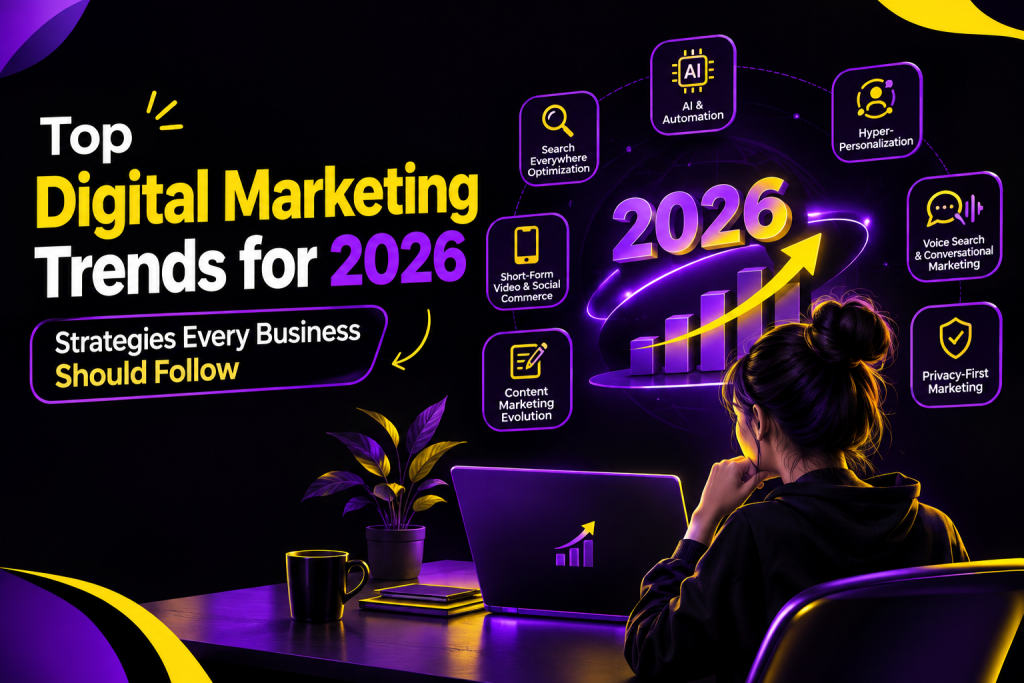
Top Digital Marketing Trends for 2026

Top Digital Marketing Trends for 2026: Strategies Every Business Should Follow Digital marketing trends in 2026 are evolving at an unprecedented rate as new technologies and consumer behaviors continue shaping the digital landscape. Organizations are now harnessing artificial intelligence and other emerging technologies to automate and personalize marketing activities. Moreover, modern customers are embracing multiple avenues to discover new products and services, including social media, video content, artificial intelligence, and interactive platforms. These developments are creating new opportunities that digital marketers can use to transform their strategies, engage customers, boost sales, and achieve other marketing objectives. Therefore, all business owners, including small-scale entrepreneurs, start-ups, and big corporations, need to identify and understand modern digital marketing trends. This blog contains vital information on the best digital marketing trends in 2026. The article highlights key issues and provides relevant background information on the topic. Moreover, the authors also give practical recommendations on how different businesses can use the trends to transform their marketing campaigns. Artificial Intelligence (AI) in Digital Marketing Artificial Intelligence has become a significant trend in modern digital marketing. Today, companies use AI to create content and analyze and track customer behavior. In particular, AI helps to optimize marketing performance, automate repetitive tasks, and obtain specific marketing insights that would take much longer to acquire without artificial intelligence. There are several ways to apply AI in digital marketing: Come up with ideas for blogs, analyze customer behavior, produce marketing reports, optimize advertising, automate repetitive tasks However, it is essential to note that AI-generated texts should be controlled by humans to ensure that they are accurate, error-free, and properly formatted. H2 2: AI-Powered Personalization Customers want relevant information and offers. AI-powered personalization allows you to give customers exactly what they want. For instance, if customers browse specific product categories on your website, you can suggest similar items or remind them of products that may be of interest to them. The same applies to email marketing, where you can send subscribers special offers based on their interests. AI-powered personalization helps to build relationships with customers and encourages them to return to your business. Thus, the advantages of using AI for personalization include: Relevancy, Higher customer engagement, Audience insights, Better marketing campaign performance. However, to achieve personalization, a company must have access to information about customers’ preferences and behavior. Therefore, it is critical to collect and use this data carefully to ensure security and privacy. H2 3: Search Everywhere Optimization Modern consumers use various channels to research and buy products and services. Therefore, it has become critical to optimize the presence in all platforms, not just Google. Optimization everywhere means that a company appears in the search results whenever a customer searches for a product or service on Google, YouTube, Instagram, marketplaces, and other platforms. In other words, an optimized website and social media accounts allow a customer to find a company at any stage of the purchasing process. For example, a customer may see an ad on Instagram, watch a YouTube review, and buy a product based on the information found on the company’s website. It is essential to implement the following optimization tips: Use keywords, optimize social media accounts, optimize YouTube, publish informative blog posts, ensure consistency of information, Therefore, Search Everywhere optimization is critical to attracting customers at different stages of the purchasing process. H2 4: Short-Form Video Marketing Short-form videos are a significant trend in social media in 2026. Thus, companies should use the popularity of Instagram Reels and YouTube Shorts to promote their goods and services. For example, businesses can post short videos to demonstrate how to use their products, provide useful tips, answer customers’ questions, show behind-the-scenes content, and much more. A clothing retailer can post styling videos, while a digital marketing agency can give marketing tips. Some ideas for short-form video marketing include: Educational content, Product reviews, Behind-the-scenes content, Answering customers’ questions. Therefore, when using short-form videos for marketing purposes, it is essential to focus on creating value for customers rather than increasing views. Voice Search and Conversational SEO Voice search is a new way for people to find information by talking instead of typing. Users are communicating with their phones, smart devices, and virtual assistants. Therefore, companies must optimize their content for voice search. For instance, instead of searching for “best digital marketing agency,” a buyer may ask for which digital marketing agency helps small businesses grow. How to optimize the content for conversational search: Make sure the frequently asked questions (FAQ) are well-organized. Use common language and answer the questions fully. Implement long-tail keywords. Remove barriers for mobile users. Moreover, the content that answers specific questions will perform better in the SERP (search engine results page) for traditional and conversational search. H2: 6. Marketing Automation Marketing automation is a technology that facilitates the marketer’s repetitive tasks. Simultaneously, it minimizes human errors. Instead of doing everything manually, professionals use programs that design, execute, and control marketing activities. Some samples of marketing automation are distributing newsletters, following up with customers, reminding buyers about abandoned purchases, and sending out marketing emails. For example, once a person subscribes to a blog, a marketer gets notified so that he can send a welcome email right away. It could include information about the company’s products and services. The benefits of marketing automation are as follows: Time and effort-saving. Helping establish effective communication with clients. Keeping track of leads. Managing and analyzing successful campaigns. Moreover, automating marketing tasks makes it easier for companies to engage with their customers without doing any time-consuming activities manually. However, it is essential that the marketers review the emails or messages periodically to make sure that everything is smooth, relevant, and personalized. Influencer and Creator Marketing Influencer and creator marketing can help companies to design effective promotional strategies. In 2026, businesses are looking to partner with creators who appeal to a certain type of customer and therefore serve as a useful channel for targeting specific audiences. For instance, a company selling cosmetics can benefit greatly

Digital Maeketing, Uncategorized

Search Everywhere Optimization: Why Your Brand Needs to Be Discoverable Everywhere

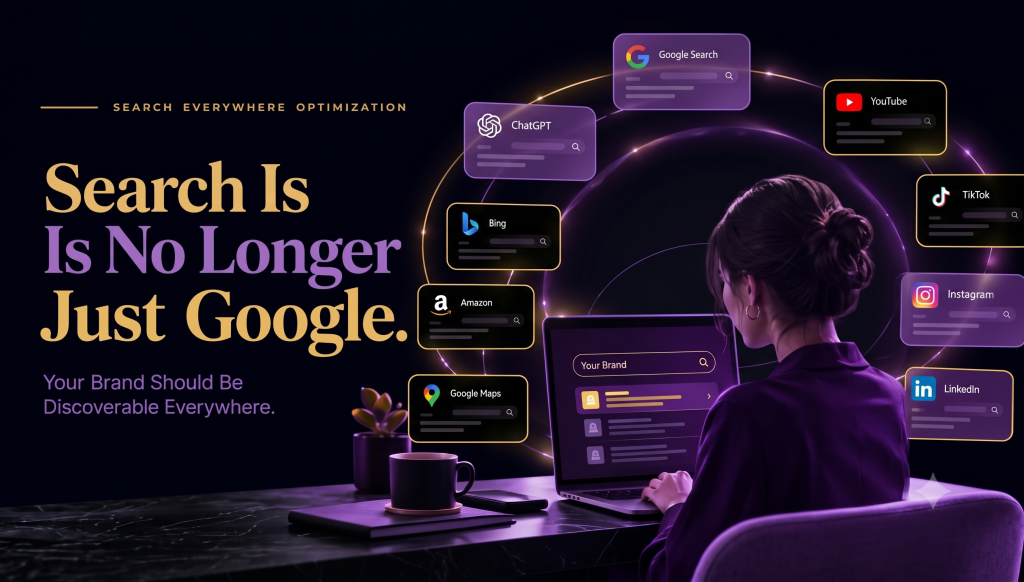
Search Everywhere Optimization: Why Your Brand Needs to Be Discoverable Everywhere Introduction   At present, there are a lot of ways to find what people are looking for — apart from using Google. Today, people use social media, YouTube, AI, online forums, and other sources to look for information, products, and services. So, this is a great opportunity for companies to be found in these places too. Search Everywhere Optimization is a new concept in digital marketing that helps companies appear in different search spaces, apart from Google. So it is beneficial for businesses to show up everywhere customers search for products or services like on social media, forums, etc. For example, a customer may find a clothing brand on Instagram, research products on YouTube, and shop on the company’s website. Hence, it is essential to help customers find companies like search everywhere. Now, in this blog, I will discuss what is search everywhere optimization and its importance. I will also provide some useful tips about this concept for your business. What Is Search Everywhere Optimization? Search everywhere optimization is the set of all measures aimed at increasing the visibility of a brand, content, products, and services in different search platforms. It includes search engines, social networks, video platforms, artificial intelligence, and marketplaces. Traditional SEO focuses on optimizing a website so that it appears in the search results of search engines. Search everywhere optimization also includes YouTube, Instagram, Pinterest, AI search, and other platforms. Each platform has its own optimization features, such as: Google — optimizing web pages and blog articles; Instagram — using keywords, hashtags, and compelling text in the description; YouTube — optimizing video files and descriptions; Pinterest — creating content and pins with keywords; AI search — developing content that will be understandable to artificial intelligence and helpful to the user. The common goal of optimizing search everywhere is to make the brand visible and easily found by users in all platforms. Why Does Your Brand Need Search Everywhere Optimization? Customers use different platforms at various stages of the buying process. Having your business found on just one channel can be limiting. Below, we highlight some key points as to why Search Everywhere Optimization is important. H3: 1. Target a Broader Audience Each digital space has its own audience that prefers discovering brands there. Some customers may search products on Google, but others may shop on social media sites like Instagram or TikTok, or watch videos on YouTube, or look out for products on digital marketplaces. Optimizing your content on these various digital spaces can help your brand reach out to a wider audience. H3: 2. Boost Brand Awareness The more customers encounter a business, the more familiar they become with it. Customers may stumble upon one of your articles on Google, see a post on your business’ social media account the next day, and watch one of your videos on YouTube a week later. H3: 3. Build Credibility with Customers Customers will always conduct research before purchasing a product or service. They research on portals such as your website, social media, through videos and demonstrations to understand a product or service better. Having a strong digital presence provides customers with the essential information they need about your business, boosting credibility and influencing their decisions. H3: 4. Drive More Traffic and Engagement Digital portals have varying traffic, which means that utilizing multiple digital spaces can boost your traffic and engagement. Google drives organic traffic, but social media can drive more engagement, while videos on YouTube or other portals can aid a customer in understanding your products and services. Customers can discover products and services through different digital portals, each of which offers something different to both the business and the customer. Key Platforms for Search Everywhere Optimization To ensure your brand’s discoverability in any platform, you must know where your target audience spends their time and what unique features each platform offers. H3: 1. Google and Other Search Engines Google is the most widely used search engine, which makes it highly important for any business. Companies can increase their discoverability on Google by creating high-quality content, using the right keywords, optimizing the website’s CTR (click-through rate), and ensuring the site’s speedy loading and easy navigation. While integrating keywords and links into the content, businesses should also create SEO-friendly URLs. Most importantly, the content created for search engines should be focused on answering questions and providing information, not on promoting the company.idders H3: 2. Social Media Networks Many people use social media networks to research brands, products, and services. Each network has its own rules and regulations about what kind of content can be posted there — so it’s essential that companies follow each network’s specific requirements when publishing any material there. Moreover, profiles on these platforms should also have keywords in their description, usernames, hashtags, etc. To increase one’s discoverability in social media means to post useful, high-quality content and actively engage with the audience. H3: 3. YouTube and Other Video Platforms Many people watch videos online to learn about products and services. A company can greatly benefit from uploading video content to a video platform because it can both entertain and inform the audience. It is critical to upload videos that will address customers’ questions and concerns. A video’s title, description, and subtitles should also contain keywords for better discoverability. Besides, companies can turn their blog posts into videos and upload them to a video platform to maximize reach. AI-Powered Search Platforms AI search tools are changing the game for those looking to do research online. From providing concise answers to a query, the new tools are able to summarize and recommend multiple resources. To be found by these search tools just remember to give concise, accurate, well-organized information that has been properly cited. Create interesting headers, answer questions, and back up your material with reliable evidence. Keep in mind that while you may not be recommended on an AI summary, good materials help to

Digital Maeketing, Uncategorized

Search Ads vs Display Ads: Which Google Ads Strategy Is Best for Your Business?

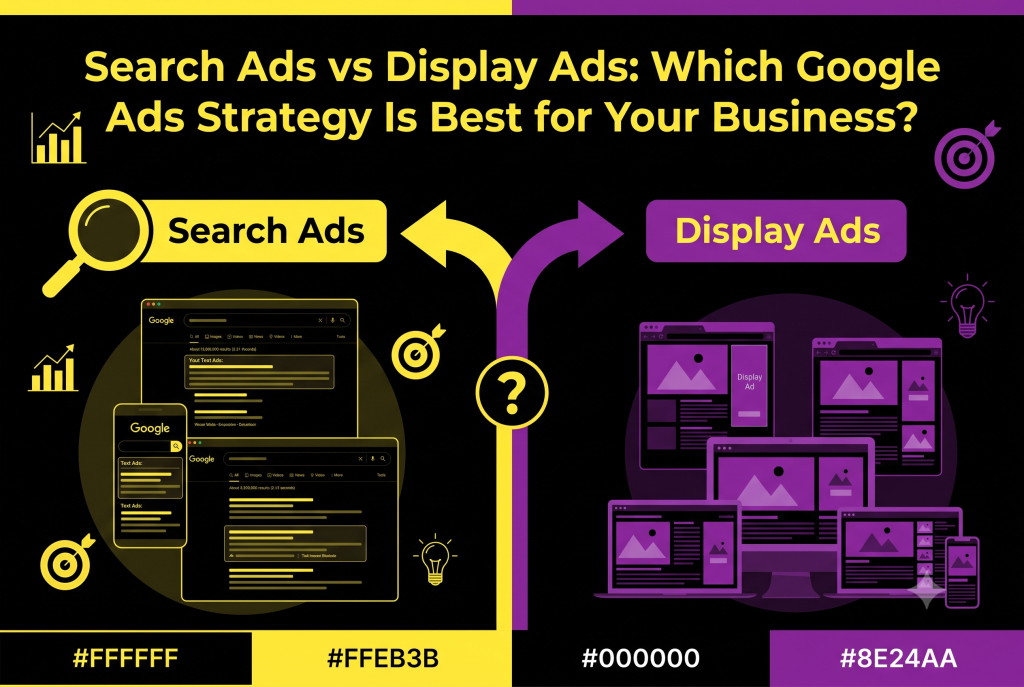
Introduction Google offers multiple advertising options that allow companies to reach thousands of potential customers online, among which Search and Display ads are the most popular. Search Ads appear when users search for specific terms related to the proposed business, whereas Display Ads utilize graphical banners for advertising. Though both ad types attract clients and increase the overall visibility of the company, their difference is crucial in terms of distinct strategies and areas of usage, which allows businesses to achieve a better understanding of the two advertising types. What Are Google Search Ads? What Search Ads areWhere they appearHow keyword targeting worksHow intent plays into itAnd how it helps businesses find customers actively searching for products and services. Give me an example Example A person searches for “digital marketing agency near me” and relevant Search Ads may appear in the search results. What Are Google Display Ads? What Display Ads are Where they can appear Visual banners and image-based advertising Audience and contextual targeting Brand awareness Remarketing Benefits of Google Search Ads H3: Reach Customers With Active Search Intent Explain how Search Ads can reach customers searching for a product, service or solution H3: Useful for Leads and Conversions Explain why Search Ads are great for businesses looking to get enquiries, calls, bookings or sales H3: Leveraging Keywords Explain how keywords play a role in connecting businesses with customers H3: Measurable Insights Explain how businesses can see how many clicks, conversions and how much they are spending on their campaigns H2: Benefits of Google Display Ads Make sure to use H3 sections: H3: Build Brand Awareness Explain how Display Ads can help build brand awareness H3: Powerful Visuals Explain how strong visuals can help support your ad and convey your message quickly and effectively H3: Useful for Remarketing Explain how businesses can retarget customers who have interacted on their website (where applicable) H3: Reach Out To Customers Across the Web Explain how Display Ads can help businesses reach relevant audiences beyond search results Search Ads vs Display Ads: Which One Should You Choose? Choose Search Ads When Your Goal Is… Generate leads Get calls Drive enquiries Increase direct sales Reach users actively searching Promote high-intent services Choose Display Ads When Your Goal Is… Increase brand awareness Reach new audiences Promote visual products Support remarketing Build interest Keep your brand visible Can You Use Search Ads and Display Ads Together? Explain how both advertisements can work together as a part of one marketing strategy. Give a simple example of a customer journey: Display ads → Awareness → Website visit → Search ads → Conversion → Remarketing Explain how you could use different ad formats throughout different stages of the customer journey. How to Choose the Right Google Ads Strategy Start With Your Business Goal Describe why companies should establish whether they want to build awareness, drive traffic, get leads, make sales, get calls, or have some other goal. H3: Know Your Audience Ask such questions as: What are they searching for? Are these people aware of your brand? What stage of the decision-making process are they in? What type of content do they want to see? H3: Set a Budget Explain that a company should set the necessary budget for the campaign depending on the goals and expected results, instead of thinking that one advertising resource is better than others without proper analysis. H3: Test and Optimize Explain the importance of analyzing the results and optimizing the campaign. Simple Google Ads Strategy for Small Businesses Step 1: Set Business ObjectiveStep 2: Set Target AudienceStep 3: Pick Search Only or Display Only or BothStep 4: Write Ads CopyStep 5: Build Landing PagesStep 6: Setup Conversion TrackingStep 7: Track PerformanceStep 8: Refine Paid Search Activities Search Ads vs Display Ads: Final Takeaway Search Ads are all about capitalizing on existing searches.Meanwhile,Display Ads concentrate on visualsandengagementThey both have their roles within the larger Google Ads ecosystem, and the choice between them depends on the specific business needs and goals. Conclusion Search Ads and Display Ads are two distinct ad types that have their own strengths and weaknesses. Search Ads are the most suitable type of ads for the people who are looking for something specific and want to find it as soon as possible. Display Ads benefit business by building brand awareness, targeting new customers, and retargeting those who already showed interest. Depending on the company’s goals, budget, and other factors, it is possible to choose one particular type of ads or use them in combination with each other. Keeping track of campaign progress and making adjustments to the strategy on time will help benefit from Google Ads many times over. FAQ…… 1. What is the difference between Search Ads and Display Ads?The Search Ads are shown in response to specific search queries initiated by internet users and the Display Ads are visual-based ads that appear across various channels like the website, etc. 2. Are Search Ads better than Display Ads?It depends if both of them are being utilized for different purposes. Search Ads can appear in search results, which will target customers looking for specific products/services whereas Display Ads can be used for retargeting and brand awareness. So, it’s always better to utilise both of them wisely. 3. When should a business use Google Search Ads?A business should utilise Google Search Ads if they want to target customers searching for products/services similar to theirs and want to generate leads, enquiries, calls, bookings, and sales. 4. When should a business use Google Display Ads?A business should utilise Google Display Ads to create brand awareness, retargeting, promote visual products and services, and utilise remarketing. 5. Can Search Ads and Display Ads be used together?Yes, a business can utilise both the ads in their marketing strategy as they have different purposes. Display Ads can create brand awareness and Search Ads can target customers searching for similar products/services. Click here

Digital Maeketing, Uncategorized

THE FUTURE OF DIGITAL MARKETING AFTER AI

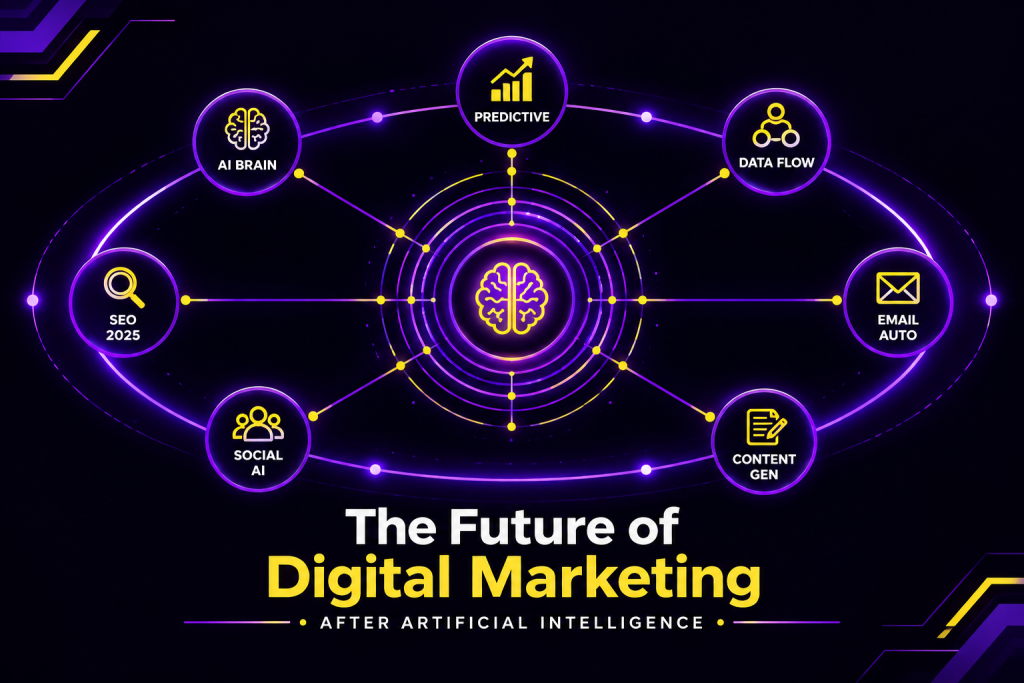
The Future Of Digital Marketing After AI Explain what digital marketing may look like as AI becomes more integrated into everyday marketing. Make sure to use relevant H3 sections. H3: AI-Powered Personalization Explain how can businesses provide more relevant content, offers, recommendations, and experiences to their customers using AI. H3: The Rise of AI Search Explain how will the rise of AI-powered search, as well as conversational search, change the game for marketing. Explain why businesses should start focusing more on: search intenthelpful and informative contentoriginal informationclear answers SEO-friendly contentconversational queriesand do notclaim that SEO will no longer matter H3: AI and Content MarketingExplain what ways will marketing teams use AI for content marketing, including but not limited to:content ideasresearchoutlinesdraftingcontent optimizationrepurposingpersonalizationExplain why human expertise, creativity, originality, fact-checking, and editing are still essential parts of content marketingH3: Smarter Marketing Automation Explain how can AI help with automating and managing repetitive marketing tasks, such as:email marketinglead nurturingcustomer segmentationanalysisreportingfollow-upsH3: AI-Powered AdvertisingExplain how can AI help with online advertising, including:audience targetingoptimizationad variationsbudget analysisad performance, insightspredictive optimizationDo not make unsubstantiated claims about what AI can do for marketingH3: AI and Customer ExperienceExplain how chatbots, virtual assistants, recommendation systems, and personalized communication will change the customer experience.Explain why human customer support still plays a vital role in addressing more complicated or delicate issues that require human empathy and support. Will AI Replace Digital Marketers? Explain that while AI can perform many monotonous tasks, effective marketing still requires:Strategic thinking CreativityJudgmentAn understanding of brandsInterpersonal communication skillsStorytelling and ethical decision-makingA deep understanding of customers Explain how marketers who understand how to use AI to its fullest extent will reap the rewards of increased productivity and experimentation, while not suggesting that AI will entirely replace marketers in the future. Skills Marketers Will Need in the AI Era AI is changing marketer’s work nature, but human expertise is undeniably significant. In the new environment, marketers are supposed to learn how to exploit the power of AI technologies and utilize their own skills and competencies. Therefore, what they should master first of all includes AI literacy, data analysis, creative thinking, strategic planning, communication, content creation, and critical thinking. Their critical role is to be able to instruct AI, evaluate its findings, identify customer expectations, and produce relevant content. As for data analysis, it will become a key skill for marketers to collect and analyze data and rely on their insights to make decisions. Overall, the future of digital marketing will not be ruled by AI; instead, it will require a close cooperation between humans and artificial intelligence. Benefits of AI for Digital Marketing Faster workflows Better personalization Improved productivity More efficient data analysis Marketing automation Better audience insights Faster content creation Improved campaign testing More scalable marketing processes Challenges of AI in Digital Marketing Incorrect AI-generated information Lack of originality Privacy concerns Overdependence on automation Generic content Brand voice problems Bias in AI systems Changing search behavior Need for human review Ethical concerns How Businesses Can Prepare for the AI-Powered Future Learn how AI can be used to help in marketingAI can be used in marketing to help carry out repetitive tasksensuring that actual work is done by humans in the marketing strategy creation and edition processhaving original and quality content creationunderstanding the audience betterhaving strong SEO foundationusing data to make decisions on the marketing strategiestesting the processes before large-scale implementationkeeping the data and information of customers safe and secureandregularly updating the digital marketing strategies. AI + Human Creativity: The Future of Marketing Lorem ipsum dolor sit amet, consectetur adipiscing elit. Ut elit tellus, luctus nec ullamcorper mattis, pulvinar dapibus leo. Common Mistakes Businesses Should Avoid When Using AI Publishing AI content without editingDepending too much on the AINot considering the audienceUsing unverified facts from AIProducing generic contentNot taking privacy into accountOveremphasizing automationNeglecting the brand’s characterExpecting marketing results too soon The Five Pillars of AI-Transformed Marketing AI can be applied in marketing from five different points: implementation of marketing processes, personalization of services, analysis of data, creation of content, and improvement of customer experience. By applying artificial intelligence in these spheres, companies can achieve higher efficiency, save time and effort, get to know customers better, find the most relevant information, and offer better services and response to feedback. What AI Is Actually Good At (And What It’s Not) AI is very effective in analyzing data, automating routine processes, generating ideas and rapidly creating content.However, they are limited when it comes to human feelings, original thought, context and make complex judgments.

Google Ads

Google AI Mode & What It Means for Your SEO in 2026

Google AI Mode & What It Means for Your SEO in 2026 Search is evolving. Users are no longer interested in simply plugging a few words into Google and clicking on the first link that appears. They are searching for more in-depth answers to their specific questions. In addition to the usual Google search, a significant trend is Google AI mode. Google AI mode is an innovative AI-powered Search experience that is designed to help users find more comprehensive answers to their queries. It is intended for complex questions, follow-up exchanges, and deeper exploration of the world’s information. As of 2026, Google has enhanced its capabilities to continue its improvements in AI-powered Search and to further enrich the discovery of websites and content on the web. What does this evolution of search mean for SEO? Does SEO suddenly become irrelevant? The answer is no. However, SEO tactics must now shift to emphasize the importance of content that is not only SEO optimized but also informative and well-structured. What Is Google AI Mode? Google AI Mode is an AI-powered Search experience that lets users ask more complex and conversational questions. Instead of searching for a few stand-alone keywords, users can ask one detailed question and then follow-up with additional questions to continue the conversation. For example, rather than searching: “best digital marketing strategy” a user could ask: “What digital marketing strategy should a small business use if they have a limited budget and want to generate leads online?” Google’s AI can decompose complex questions into related subtopics, and perform a search across multiple areas to create a more expansive view of the topic. Google refers to this as query fan-out. AI Mode can also work with different forms of input, including text, voice, and images. Google launched AI Mode in India in 2025, letting users ask questions, explore topics with follow-ups, and get links to relevant web content. Google AI Mode vs. Traditional Google Search Google AI Mode vs. AI Overviews What Are AI Overviews? AI Overviews can give you an AI-powered summary within Google Search for certain queries. They can help introduce a topic quickly, and will include links for further reading. What is AI Mode? AI Mode lets you go deeper into a more conversational search, and follow up on related queries. You may remember Google began testing different AI-powered search experiences, and recently began testing the ability to transition between them. In 2026, Google introduced a unified vision for an AI-powered Search experience, where users can move from an AI Overview into AI Mode, and follow links to related topics. Why Does This Matter for SEO? It implies that businesses need to think beyond targeting one keyword. Your content should be informative enough to answer questions and address related questions that your target audience will have. What Does Google AI Mode Mean for SEO in 2026? The growth of AI-powered Search does not spell doom for SEOs. Rather, it is a transition away from a narrow focus on content quality and relevance to a more holistic consideration of contextual appropriateness, search intent, website accessibility, and end-user requirements. Some trends that businesses should be aware of are as follows: Search Queries Are Becoming More Conversational It is now possible to ask Google more nuanced questions in a more natural language. Google announced in 2026 that, on average, an AI Mode query in the United States was three times longer than a regular Search query. As such, businesses should take advantage of this shift and focus on creating content around questions, rather than simply keywords. For instance, instead of just focusing on the keyword ‘SEO services’, a company could also create articles or web pages answering the question ‘how can SEO services aid a small business in gaining more website visitors?’ Long-Tail Keywords Are Becoming More Useful Examples may include: questions about improving your local SEO as a small business, the benefits of SEO for an e-commerce site, the best content marketing practices for a start-up, or ways to boost your website’s organic traffic. Your customers’ search queries will often tell you exactly what they are looking for. Therefore, it is vital to answer them truthfully and thoroughly to provide the best possible solution. Content Must Answer Real Questions One of the most common mistakes companies make is creating content for the sake of keywords. Ask yourself, Does this article actually help the reader? A good article should have explanations, examples, information, and answers to related questions. Google has also begun prioritizing connecting users with useful websites, original content, and first-hand experience in their AI Search features. How to Optimize Your Website for AI Search There is no secret sauce that can ensure that one’s website appears in AI-generated Search results. However, businesses can take a number of steps in order to improve their presence. Following the best SEO and content creation practices can improve the likelihood of getting discovered. Make the Articles Useful and Differentiating It is important to note that one should not write generic articles that do not offer any additional value. One’s articles should rather include one’s own advice, examples, research, case studies, experiences, expert opinions, and unique perspectives The more useful the article is for the reader, the more valuable it is. Understand Search Intent Before creating an article, learn to understand the query. A person searching for “what is SEO” would probably want a definition Someone searching for “SEO agency near me” is likely to click on the first result But a person searching for “SEO pricing for small businesses” might want a price comparison Understanding the intent behind a search can help us create articles that answer questions and solve problems. Use Conversational Keywords Naturally You don’t need to write awkward sentences in an attempt to include keywords. Instead, you can ask questions throughout your content. For example: H2: How Can Small Businesses Improve SEO? And then answer the question below it. That way, it’s much easier to both read and understand

Uncategorized

“Generative Engine Optimization (GEO): The Future of Search”

The article should be suitable for a professional digital marketing agency website and easy enough for beginners, small business owners, marketers, startups, entrepreneurs, bloggers, and business professionals to understand.Explain Generative Engine Optimization (GEO) in simple language and help readers understand how search is changing with AI-powered search engines and answer engines. Generative Engine Optimization (GEO): The Future of Search Explain how people are relying more and more on AI-augmented search experiences to find information, compare and contrast, summarize, and get straight answers to questions. Introduce GEO as an approach that focuses on raising the probability that relevant website information is gleaned, surfaced or cited by AI-generated responses What Is Generative Engine Optimization (GEO)? Definition of Generative Engine OptimizationWhy the term GEO is being usedHow GEO fits in with traditional SEOThe goal of being informative and helpful to searchers, building trustworthy content that’s easily discovered and understood by AI-driven search Explain that GEO is a fledgling field and certain practices and terminology are still changing How Does GEO Work? Understand a user’s question Interpret context and intent Retrieve or use information Compare information from different sources Generate a natural-language response Potentially provide links or citations to sources Avoid pretending to know the proprietary ranking or retrieval systems of specific AI platform Why Is Generative Engine Optimization Important? Explain why marketers are getting so interested in GEOs Discuss the changes in the way people search for informationthe rise of AI-driven searchthe importance of visibility in the right placesand the value of providing information that people actually need.Also, explain why companies need to change their content strategies Make sure to keep your claims objective and avoid suggesting that traditional search engines are becoming irrelevant. GEO vs SEO: What’s the Difference? Key GEO Strategies for Better AI Search Visibility Key GEO Strategies for Improving Search Visibility The process of generative engine optimization aims to improve the visibility of material in the search results of AI-driven discovery systems. However, contrary to popular belief, it is not focused on keywords. Rather, it emphasizes clarity, quality, and reliability of information. 1. Write informative and original content Produce informative and original content to improve the visibility of your material. Focus on addressing specific questions and offering relevant information. Remember to supplement your arguments with additional data, examples, and personal or professional insights. 2. Answer questions directly and clearly Address the questions you receive in your field directly and clearly. Structure your material in a way that makes the most sense and is easiest to follow. Use subheadings, brief paragraphs, lists, FAQs, and Q&As to make the most important information easy to spot. 3. Provide examples and expert insights Make sure to include examples and expert insights when appropriate. Doing so might help you demonstrate the value of your content. Moreover, it can facilitate the creation of better-quality material. 4. Establish topical authority Build topical authority by developing a comprehensive piece of content about a particular topic. Create supplementary material regarding the same subject and link to it to build an internal network of resources. 5. Provide clear definitions and explanations Explain all the necessary definitions and terms clearly and concisely. Support all the claims you make with reliable and credible evidence. Moreover, remember to omit any unsupported information. 6. Update content when necessary Update old content if new data, statistics, links, examples, or recommendations become available. It will benefit both the readers and search engines. On the one hand, you would be able to provide more relevant information. On the other hand, you would improve the search engine optimization of the material. 7. Use descriptive subheadings and supplementary elements Use descriptive subheadings and supplementary elements, such as lists, tables, and FAQs. The presence of these elements, along with relevant internal links, will make your material easier to process for both humans and machines. Overall, GEO is not about optimizing for artificial intelligence. Rather, it is about providing high-quality information in an accessible manner. In doing so, you would both satisfy and educate your audience. Moreover, you would improve the overall search visibility of your material. How to Optimize Existing Content for GEO The optimization of the existing content for GEO is the process of editing and enhancing the performance of the current pages in order to make the information on them more accessible and better perceived by the readers and algorithms. In addition, the optimization of the existing content may be a great option to improve the quality of content and increase the efficiency of the content strategy. 1# Understand Search Intent To optimize the existing content for search engines, first, you need to research the search intent of the keyword you are going to optimize. The content has to fully respond to the request and answer the questions and/or solve the problems of the readers. 2# Know the Most Asked Questions Make a list of the most common questions related to your optimized topic. Then, incorporate them into your text and try to answer them fully and in detail. 3# Optimize the Structure of Your Text Highlight the most important parts of your text with subheadings (H2 and H3), bullet points, and numbered lists. Additionally, you can also use tables to make the information on the page more accessible and easy-to-read. 4# Provide Direct Answers When optimizing text for search engines, make sure to answer the most common questions upfront and give additional information after that. 5# Additional Information, Sources, Examples, and Expertise Add more information, statistics, and data to your optimized text. Cite the sources you used for research, provide examples and cases, and increase the quality of content by adding your expertise and knowledge. 6# Update the Information on the Page When optimizing your old content, remember to update the information on the page if necessary. Check the facts, numbers, links, sources, examples, screenshots, and other elements. 7# Interlinked Content Interlink the related pieces of content using the appropriate anchor text. GEO Best Practices for Businesses Write for people firstUnderstand search intentProvide answears to

AI SEARCH, Uncategorized

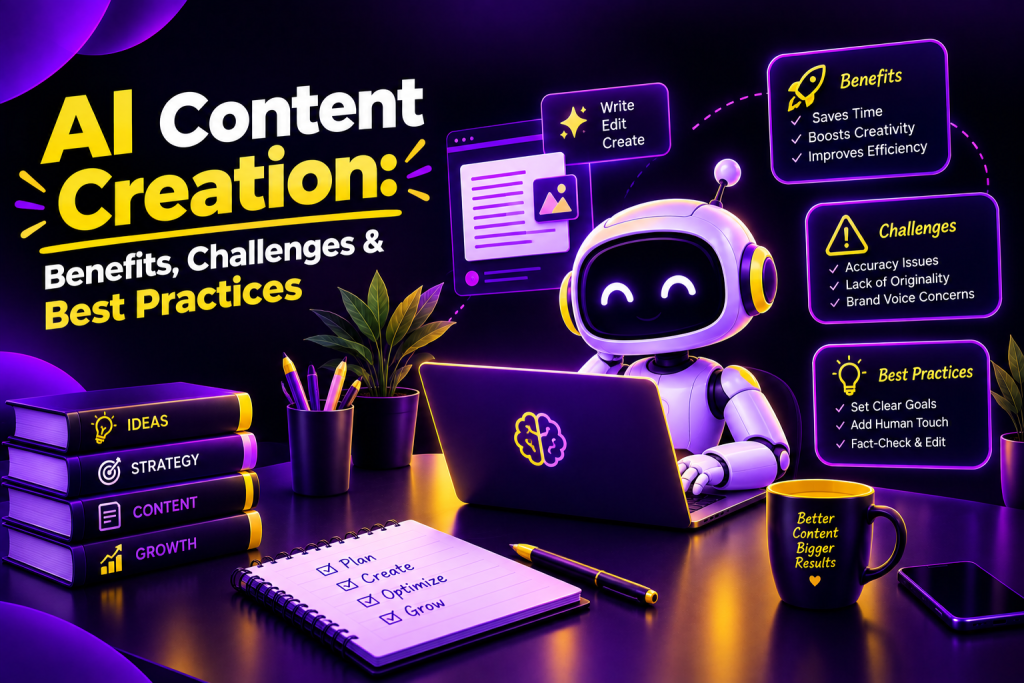
“AI Content Creation: Benefits, Challenges & Best Practices”

What Is AI Content Creation? Definition of AI content creation How generative AI works at a fundamental level What content can be created with AI Examples of AI-generated content How businesses and marketers can use AI H3: What Can AI Help You Create? Give examples including but not limited to: Blog ideas Blog drafts Social media posts Emails Product descriptions Ad copy Video scripts Content outlines Headlines SEO content ideas Content repurposing H2: Benefits of AI Content Creation Clearly explain the key benefits Use subheadings for the most important benefits H3: Saves Time Explain how AI can help with researching, brainstorming, organizing, outlining, writing, and editing H3: Helps Generate Content Ideas Explain how AI can help overcome writer’s block challenges H3: Helps Ensure Content Consistency Explain how businesses can leverage content generation tools to maintain a consistent publishing schedule H3: Helps Personalize Content Explain how businesses can create multiple variations of the same article to personalize for different audiences H3: Assists With SEO and Content Strategy Explain how businesses can use AI content generation tools for keyword suggestions, article structures, search intent, topic clusters, and other SEO and content strategy considerations while emphasizing the need for human review H3: Helps Small Business Explain how small businesses with limited time and resources can use AI content generation to support their content marketing needs 7. CHALLENGES SECTION H2: Challenges of AI Content Creation Explain that while AI content creation presents many benefits, there are also potential drawbacks H3: Lack of Original Human Perspective Explain how content created with AI lacks the benefit of human insights, including a human perspective, unique viewpoints, and even creativity H3: Accuracy and Inaccuracy Explain how AI content generation tools can produce both accurate and inaccurate information, including out-of-date information, and encourage users to seek additional information to confirm accuracy H3: Generic or Repeating Content Explain how content created with AI can lack uniqueness, brand voice, and personality, especially if the user simply copies content generated by AI without making modifications H3: Brand Voice Concerns Explain that businesses and brands must review content created with AI to ensure that it reflects the desired brand voice, audience, and personality H3: SEO and Quality Concerns Explain that simply generating large volumes of content with AI does not guarantee SEO value or quality content, and emphasize the importance of relevance, originality, accuracy, search intent, and audience appeal 8. BEST PRACTICES H2: Best Practices for AI Content Creation Give clear, actionable business writing advice, such as: Use H3 headings for each best practice H3: Define Your Content Objectives Explain the importance of defining what you want to accomplish with each written piece H3: Provide Clear Instructions to AI Explain how being specific and clear with instructions helps the AI respond more accurately H3: Leverage Human Expertise Explain how writers and other professionals can add value to AI-generated content by providing their own expertise, examples, experiences, and insights H3: Double-Check Stats, Facts, Figures, Quotations, and Dates Explain the importance of fact-checking and verifying information, especially statistics, facts, figures, dates, specific quotations, and product or industry information H3: Edit for Brand Voice Explain how businesses can edit AI-generated content to reflect the appropriate tone and brand voice H3: Keep the Reader in Mind Explain the importance of creating content that serves the reader and provides value to the reader rather than focusing on keywords or other search engine optimization concepts H3: Use AI as an Assistant, Not a Crutch Emphasize the importance of ensuring that humans are involved in the content creation process AI + HUMAN COLLABORATION AI vs. Human Content Creation: Why Both Matter AI Strengths human Strenth AI CONTENT CREATION WORKFLOW A Simple AI Content Creation Process Explain a process or task in a simple way. You need to create a step by step guide on how I would approach writing a blog post. H3: Step 1 – Defining your audienceH3: Step 2 – Pick a content goalH3: Step 3 – Do keyword research on your topicH3: Step 4 – Write a prompt for an AI content writerH3: Step 5 – Get an initial draft from the AI toolH3: Step 6 – Apply expert knowledge and human skillH3: Step 7 – Fact checking and editingH3: Step 8 – SEO optimizationH3: Step 9 – Publishing the blog post and measuring results COMMON MISTAKES Common AI Content Creation Mistakes to Avoid Essay Explain mistakes such as: Publishing unedited AI contentUsing wrong informationKeyword stuffingGeneric content creationLack of focus on the target audiencePlagiarismOverreliance on AILack of brand voiceCreating content for search enginesFailure to evaluate content’s success FUTURE OF AI CONTENT CREATION The Future of AI Content Creation Address the ways in which AI may continue to influence: Content personalizationMarketing automationMultichannel contentVideo and visual contentContent repurposingData-driven content strategiesCustomer experiences CONCLUSION AI can make content creation faster, more efficientAI has many benefits but also limitationshuman creativity and expertise is still importantFact-checking and editing is always crucialBusinesses need to strategically use AI instead of mindlesslyThe best content creation uses a mixture of AI and human skills. Frequently Asked Questions(FAQ) 1. What is AI content creation?AI content creation is the use of artificial intelligence tools to support the writing process, develop blog and social media posts, construct emails, compose product descriptions, write scripts, and produce other marketing content. 2. What are the main benefits of using AI content creation?The benefits of using artificial intelligence to create content include time-saving, generating ideas, planning content, being more productive, and creating different types of content. 3. Can AI-written content be used for SEO?Artificial intelligence can be used to create SEO content, including coming up with topics, developing an outline, doing keyword research, and writing the draft. It is to be noted that the produced content should be informative and accurate, have proper keywords, and be checked by a human before publication. 4. Can AI replace copywriters?AI can support copywriters in many tasks, ranging from ideation to proofreading. At the same time, copywriting requires professional expertise, knowledge, and skills that only people can

Scroll to Top